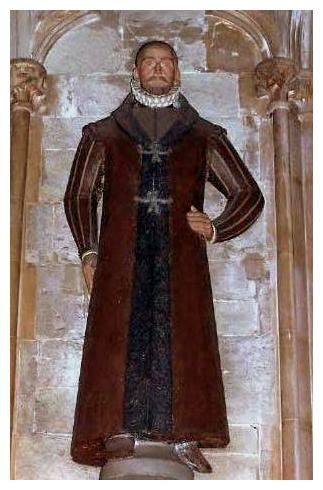
Sir THOMAS PERCY, 1536
"For whom do you stay? I will not obey the commandment of the King, but the commandment of God which was given by Moses." —2 MACH. vii. 30.
See
PILGRIMAGE OF GRACE (1)
CLEANSING THE TEMPLE
THE ABOMINATION OF DESOLATION
ENGLISH-SCOTTISH- WELSH- IRISH MARTYRS Between 1535 and 1681, over 600 Catholics died for the Catholic Faith and for the primacy of the Roman Pontiff, 54 were beatified in 1888 and nine more in 1895; 247 others had their cause of beatification introduced in 1886, being declared Venerable; the remainder (about 286), though they all died heroically, led more obscure lives. 40 were canonised in 1970.
Posted by
Christopher Gillibrand
at
8:18 AM
0
comments
Links to this post
Labels: 1536, Sir Thomas Percy

Posted by
Christopher Gillibrand
at
8:02 AM
0
comments
Links to this post
Labels: Pilgrimage of Grace, Sir Robert Aske
Posted by
Christopher Gillibrand
at
4:43 AM
0
comments
Links to this post
Labels: Abbot, John de Feckenham, Westminster
Posted by
Christopher Gillibrand
at
4:49 AM
0
comments
Links to this post
Labels: 1572, Blessed, priest, Thomas Plumtree

Posted by
Christopher Gillibrand
at
7:31 AM
0
comments
Links to this post
Labels: 1585, Abbot Feckenham, Benedictine
Posted by
Christopher Gillibrand
at
8:13 AM
0
comments
Links to this post
Labels: 1600, Layman, William Blundell
Posted by
Christopher Gillibrand
at
6:33 AM
0
comments
Links to this post
Labels: 1600, Layman, William Blundell
THE SLEEP OF THE JUST
A NATIVE of Rodesby, Derbyshire, as a fellow of Exeter College, Oxford, he was accounted as an acute philosopher and an excellent Greek and Hebrew scholar. But grace called him to yet higher distinction. He became a Catholic, entered the English College, Rome, (also here for more history) and returned a priest to England in August 1580. After some months' zealous work he was apprehended while preaching in Mr. Roscarrock's house, and imprisoned, first in the Marshalsea and then in the Tower. He was there nearly a year, and in divers conferences with ministers won the admiration of his audience. After his first racking he was set out in great snow, and Mr. Roscarrock was kept in a dark corner hard by to hear his pitiful groans. After his second racking he lay five days and nights without food and in silence. All this time he slept, as he thought, before our Saviour on the Cross, and on coming round found himself free from pain. Tortures unavailing, the Bishops of Canterbury and London offered him the second Bishopric in England if he would but go to St. Paul's Church. After B. Campion was executed, the hangman took hold of Sherwin with his hand all bloody to terrify him, but the martyr reverently kissed the martyr's blood, and then shed his own, December 1, 1581.
"When He shall give His beloved sleep."— Ps. cxxvi. 2.
Posted by
Christopher Gillibrand
at
2:01 PM
1 comments
Links to this post
Labels: 1581, Ralph Sherwin, Rodesby, saint, Tyburn, University of Oxford
Posted by
Christopher Gillibrand
at
12:40 PM
1 comments
Links to this post

"She shall crush thy head" GEN iii. 15
Posted by
Christopher Gillibrand
at
12:16 AM
0
comments
Links to this post
Labels: Immaculate Conception
FAITH AND WORKS
Biography
AT the scaffold one of the preachers urged that the Catholic Church taught that good works justified faith. Almond answered that faith and good works justified together. The minister said that faith alone justified. He asked what faith an infant could have ere he had the use of reason ? The minister left that question and reason and talked of something else. On the scaffold, kneeling down, he humbly begged God's mercy, not doubting that, many as his sins were, Christ, by His death and the shedding of His blood, would remit and pardon, and that He would now accept his willingness to shed his blood for His greater glory. " What," said a minister, " can you match and compare Christ's bloodshedding with yours? Cannot Christ by Himself work your salvation?" "You mistake me," replied the martyr; "my sins, though venial, deserve Christ's wrath and punishment. It is His death alone, and the shedding of His blood alone, that is not only efficient but also sufficient to save us all. I have not much more to say, one hour overtaketh another, and though never so long at last cometh death, and yet not death, for death is the gate of life unto us, whereby we enter into life everlasting, and life is death to those who do not provide for death."
" Faith without works is death."—JAS. ii. 20.
Posted by
Christopher Gillibrand
at
2:18 PM
0
comments
Links to this post
Labels: John Almond, priest, Venerable
The Beginnings
The first official movement for the canonization of the 'great cloud of witnesses' (cf. Hebrews 12:1) who gave their lives in defence of the Catholic religion, from the time of the schism under Henry VIII (1534) until the end of the seventeenth century, began during the pontificate of Urban VIII (1623-44). In 1643, at the request of the English Benedictines in exile, the Pope appointed the Archbishop of Cambrai in northern France (in default of the existence of Catholic Bishops in England and Wales) to set up an official process to collect and examine the evidence for the cause, fact and constancy of martyrdom of all those who were known to have suffered for the faith up to that time. Unfortunately, all attempts to collect the evidence were thwarted by the English authorities and the task had to be postponed. All the time, however, the victims of the long drawn-out persecution continued to be regarded and venerated as true martyrs, abroad as well as in secret at home (cf. Bishop Challoner's Memoirs of Missionary Priests, first published 1741-42, most recent edition 1924). When England's Catholic Hierarchy was at last restored in 1850, work on the cause of the martyrs began in earnest. The devotion and knowledge of men like Fr John Morris, Dom Bede Camm, Fr John H. Pollen and others, led to successive petitions to the Holy See by the restored English and Welsh Hierarchy, in 1859, 1866 and 1874, requesting the authorization of a process that would lead to the beatification and canonization of the martyrs. The necessary permission was eventually given, and a process was held at Westminster in 1874, to investigate the causes of 353 servants of God, to which another eight were later added. On examination of the evidence by the Sacred Congregation of Rites in Rome, forty-three of these were almost immediately postponed on the ground that the proof of martyrdom was not sufficiently cogent, while the cause of the others was further investigated.
The 'Equipollents'
During the ensuing discussions in Rome (called the 'Apostolic Process') special attention was given to the frescoes painted in 1583 in the Venerable English College, Rome, which were patently inspired by the veneration contemporaneously paid to sixty-three martyrs who had suffered in England during the reigns of Henry VIII and Elizabeth I up to that time (1535-1583): a devotion which had endured through the centuries to the extent that such veneration was judged by Pope Leo XIII to constitute a legitimate and immemorial cult. In accord with the legislation established by Urban VIII, such a confirmation of cult was the equivalent of papal approval of the fact of martyrdom;1 it resulted in the beatification of sixty-three martyrs (fifty-four on 29 December 1886, and nine more on 13 May 1895) equipollently or per viam cultus.
Two of those equipollently beatified in 1886, John Fisher and Thomas More, were perhaps the best known of all the martyrs of the Reformation because of their consistent mention in the history of the time as men of special eminence: the one a Cardinal of the Holy Roman Church, the other Lord Chancellor of England. After the beatifications of 1929, a massive petition from the Catholic Church in England and Wales persuaded Pius XI to authorize an exhaustive examination into the fact and cause of their martyrdom; the outcome was the canonization of these two martyrs on 19 May 1935.
Beatification of 136 Martyrs (1929)
In the light of numerous publications and intensive historical work in the first two decades of the present century, the Sacred
Congregation of Rites authorized Cardinal Francis Bourne, then Archbishop of Westminster, to resume the Apostolic Process (begun in Rome in 1880) on 15 June 1923. The process took six years to complete; and although 234 martyrs were finally cleared for formal beatification by the Promoter of the Faith (popularly known as the Devil's Advocate), only 136 were beatified. That left 116 martyrs, whose causes, the Apostolic Letter declared needed further study 'in order that their martyrdom might be more clearly manifested.'
The Canonization of Forty Martyrs (1970)
(Cf. The Canonization of the Forty English and Welsh Martyrs: Commemoration presented by the Postulators of the Cause (127 pp., with photographs of the Canonization Ceremony, Office of the Vic Postulation, London, 1971).
The outbreak of the Second World War, and the many difficulties experienced in giving fresh impetus to the historical study of the lives of the great number of the Blessed Martyrs, and stimulating devotion to them, caused a hiatus in the normal progress from beatification to canonization. Eventually the Hierarchy decide to petition the Holy See for the reassumption of the cause of small group of martyrs, according to specific criteria: firstly, the extent and quality of the devotion to certain beati amongst the whole group; and secondly, their representative nature with regard to place of origin, state in life, and so on. In 1960, the Holy See agreed that this group, when it was eventually draw up, should form one cause. From the historical point of view, was judged necessary to present documentary proof of martyrdom of those equipollently beatified (the first eleven of the forty This proved to be a very sizeable task: a fact confirmed by the publication in 1968, by the Historical Section of the newly established Sacred Congregation for the Causes of Saints, of volume of more than four hundred pages.( Cause of the Canonization of the Blessed Martyrs John Houghton, etc Official Presentation of Documents on Martyrdom and Cult (xliii -379 pp. Vatican Polyglot Press, Rome, 1968).In addition to the historical research, the Holy See required proof of widespread devotion to the group of forty, and also the presentation of two authentic miraculous interventions through the martyrs' intercession. After preliminary enquiries into a great number of alleged cures, two cases were eventually selected on the advice of the medical panel of the Sacred Congregation. Special tribunals were set up in the dioceses where they took place, and the exhaustive examination of one of the cases proved positive: it was declared to be miraculous in the strict sense. By the gracious intervention of Pope Paul VI, further investigation into the second cure was dispensed with, and in May 1970 the Pope announced that the canonization of these martyrs would take place in St Peter's on Sunday, 25 October 1970.
……..
Extensive section removed on ecumenical aspects
(The reality of their sanctity and their intercession in the heavenly courts could not be affected by ecumenical considerations, despite the reservations of the British Council of Churches which were waived on 17 December 1969 with the statement which can be judged for itself that all Christians share in “the martyr tradition as one in which all have shared and which all may draw strength”. Subsequent decisions by the Anglican Church have rendered the passage entirely redundant)
The Resumption of the Cause of Beatification of eighty-five Venerable Martyrs
(Since the rescript of St Pius X (26 August 1913), the title 'Venerable applies only to those servants of God whose virtue has been declared heroic, but are not yet beatified. Formerly, the title was conferred soon as the cause was formally introduced in Rome (the opening of Apostolic Process). It still applies to those whose causes were thus introduced before 1913, but who have not yet been beatified.)
When the cause of the Forty Martyrs was resumed, the Hierarchy simultaneously decided that the directive of the Holy See concerning these martyrs whose causes of beatification were postponed in 1929 should be implemented. This was especially opportune, seeing that the resumption of the cause of the forty was accompanied by a renewed interest in the whole field 'recusant history'. The first task was to discover whether contemporaneous documentation on the fact of martyrdom of the 116 martyrs who were not beatified in 1929 was still extant. It soon became clear that there was little hope of establishing sufficient evidence of martyrdom for ten Venerable martyrs who had suffered during the reign of Henry VIII; and gradually, as the research went forward, others had to be eliminated, either for a similar lack of documentary evidence, or because it became impossible to disentangle the true motive of martyrdom from the political involvement of the individuals concerned.
The documents concerning the cause, fact and constancy of the martyrdom of the Venerable George Haydock and his eighty-three companion martyrs, which were declared authentic by Cardinal Hume, the present Archbishop of Westminster, on September 1978, were received by the Historical Section of the Sacred Congregation for the Causes of Saints at the beginning of October. Those on Venerable George Douglas were added later (see p. 44). More accurate versions of the pertinent documents already submitted in the processes of 1874 and 1923-29 were provided, and many new documents added; whilst all likely sources in public and private archives and libraries at home and abroad— especially in Rome, Brussels, Madrid, and Valladolid—have been searched, in order to render the documentation as complete as possible.
The documentation submitted deals substantially with the martyrs' arrest, examination, trial, sentence and execution; and though official trial records are extant only in relatively few cases, equivalents have been discovered and presented. These are mainly contemporary or early accounts of martyrdom, establishing the charge on which the various martyrs were condemned, and also frequently recording the sentiments with which they received their sentence, their edifying words and courageous bearing in the scaffold.
Seventy-five of them were condemned under the statute of Elizabeth I passed in 1585, 'against Jesuits, seminary priests and such other like disobedient persons.' According to this law, Catholic priests returning to England after ordination abroad committed high treason by their very presence on English soil, whilst those who assisted them in any way were guilty of felony: the sentence in the first case was death by hanging, drawing and quartering; in the second by hanging only.
Of the ten remaining martyrs, Haydock the priest and Carter the layman were hanged, drawn and quartered for allege committing high treason under the ancient statute of 1352 (Edward III). A priest and six laymen were condemned for being reconciled or persuading others to be reconciled to the ancient Faith: acts declared to be treasonable under the Elizabeth statute of 1581. Finally the layman, John Bretton, was arraingned for allegedly uttering 'seditious words and rumours against Queen's Majesty': a felony punished by hanging.
All these eighty-five men, priests and laity, were regarded from the time of their death onwards by their fellow Catholics at home and abroad as martyrs for the Faith.
…..
James Walsh, S.J.
Vice Postulator
Feast of St Edmund Campion and his fellow-martyrs, 1978
The Eight-Five were subsquently beatified on 22nd November 1987
Posted by
Christopher Gillibrand
at
1:40 PM
0
comments
Links to this post
Labels: Beatification, Canonisation
Posted by
Christopher Gillibrand
at
2:32 AM
1 comments
Links to this post
Labels: University of Oxford


Posted by
Christopher Gillibrand
at
5:29 AM
3
comments
Links to this post
Labels: 1577, Cuthbert Mayne, Douai, priest, saint, University of Oxford
THE MARTYRS' SHRINES
BORN in or near York, he was a devout Catholic, and was deprived of a pension which he had, owing to his fidelity to the old religion. With the desire of consecrating his life to God he went over to Rheims in the summer of 1580, but fell so ill that his life was despaired of. He, however, begged Dr. Allen to allow him to be ordained without delay, as he believed God intended to empfoy him on the English Mission. A dispensation was therefore obtained from Rome, and he received all the Sacred Orders within twelve days, in May 1581, though he was so ill that he could scarcely stand. He regained sufficient strength to proceed to England, but was arrested in the city of York, August 11, 1582, after scarcely a year's apostolate. He confessed that he was a priest, and refused the oath of Supremacy or to fight against the Pope. He was led to the Castle prison in double irons on November 25, was tried and condemned, and on November 28 suffered at York Tyburn. In her visits to his grave and that of the other martyrs under the gallows, Margaret Clitheroe found strength for her own passion.
"And she rendered to the just the wages of their labours and conducted them in a wonderful way, and was to them" for a covert by day and for the light of the stars by night."— WISDOM x. 17.
Posted by
Christopher Gillibrand
at
9:22 AM
0
comments
Links to this post
Labels: 1582, Blessed, James Thomson, priest
Posted by
Christopher Gillibrand
at
9:35 AM
0
comments
Links to this post
Labels: 1596, George Errington, Venerable
"In the cold early hours of November 6th, 1605 Thomas Bates, servant to Robert Catesby, rode over the moat bridge of Coughton Court and climbed the stairs to the Drawing Room on the first floor of the Gatehouse, with its wide view of the surrounding countryside.
The group of people he found there were all closely involved in the then illegal Catholic community and were all used to danger and the fear of discovery. But what they were about to hear meant peril beyond anything they had experienced, and was to change their lives forever.
There were two Jesuit priests - Father Henry Garnet, who had celebrated a clandestine mass for the Feast of All Saints in the house just a few days before, and Father Oswald Tesimond, the confessor to Robert Catesby. There was the family of Sir Everard Digby who had rented the house, Nicholas Owen, the famous priest-hide builder, and finally the Vaux sisters who aided Father Garnet, and who were related to the Throckmorton owners of the house, to Bates' master Robert Catesby, and to several of the men they were about to hear of.
Thomas Bates did not have good news. He had to tell those gathered there of the details of the Gunpowder Plot, the plan to blow up the Houses of Parliament, of its failure, and that the conspirators included Robert Catesby, Sir Everard Digby, and the Wintour brothers among others, were now all running for their lives.
Lady Digby was overcome with distress at the danger her young husband found himself in, while Father Garnet was angered at such an action that he had warned against in principle, and in failure could only mean extreme hardship for the already beleaguered Catholic community.
Posted by
Christopher Gillibrand
at
1:59 AM
0
comments
Links to this post
In the persons, places and dates section, the posts are categorised according to name, religious order, date of martydom, place of birth, place of death and other key associations such as the Northern Rising.
Keep scrolling down!
Previously posted material is also being updated. There are a few problems with the titles of earlier posts, which will be corrected soon.
Contact me gillibrand@belgacom.net with comments, information and even corrections if necessary.