Visit the Bookshop


Sunday, September 28, 2014

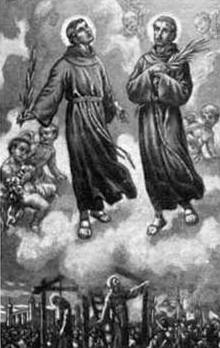
Blessed JOHN WOODCOCK, Franciscan, 1646

PETITION FOR RE-ADMISSION

Biography

"THE more conscious I am that it is better to be poor in the House of the Lord than to abide in the tabernacles of sinners, so much the more the conviction of my soul still unaccomplished grows stronger in the day and night, and the former direction of my conscience, disturbed in spite of myself from its original seat and form, incessantly solicits and urges me on ; so that the desire for its reformation, no less than that sudden fall" (he had withdrawn as a postulant) " which threw both it and my whole being into confusion, inflames my soul. Wherefore, my dear Father William (I suspect this to be the head of the English Franciscans at Douai), I beseech you by our old friendship, which in this misfortune intercedes for me with you, to take pity on my miserable state, and apply yourself to obtain my pardon and the favour of my restoration. This is my desire, this I ask, this I wait for, for this I sigh and groan, and I desire it for no other motive than the pure love of God and His glory. That which you saw me previously desire lightly, strive now for Christ's sake to obtain for me more efficaciously. This will be my greatest happiness, and nothing whatever can add thereto. Farewell."

"The prayer of him that humbleth himself shall pierce the clouds."—ECCLUS. xxxv. 21.

Saturday, September 27, 2014

+ Bishop THOMAS WATSON OF LINCOLN, 1584

PEACEMAKER

Biography

A BRILLIANT scholar, master of St. John's College, Cambridge, he took the oath of Supremacy under Henry VIII, but maintained in all other points the Catholic faith, and for preaching in its defence was imprisoned for a time by the Protector Somerset, together with Bishop Goodman, whose chaplain he was. By order of Mary he preached before her at Paul's Cross, and refuted the contradictions of the new teaching. Promoted Dean of Durham and Bishop of Lincoln, he was imprisoned by Elizabeth for contempt and contumacy, and began a long course of suffering either in public or private custody. He writes to Cecil, October 6, 1578, that two infirmities drove him to crave for succour—blindness and lameness. He had lost one of his eyes, and the other was so weak he could scarce see the meat on the table. His lameness was due to sciatica in both his thighs. His last confinement was at Wisbeach (the Castle, used as a special prison for Catholics shown here but eighty years later)


where he used all his influence, in the strife then prevailing, to promote peace and charity, and with great success. He died September 27, 1584, having proved by twenty years of bonds his repentance for his early fall.

"I beseech you, brethren, by the name of our Lord Jesus Christ, that you all speak the same thing, and that there be no schisms among you." —1 COR. i. 10.

Friday, September 26, 2014

Venerable OLIVER PLUNKET, Archbishop, 1681

A FAIR TRIAL

Biography

AFTER his condemnation, he wrote to Father Corker, his fellow-prisoner, as follows : "I am obliged to you for the favour and charity of the 20th, and for all your former benevolences; and whereas I cannot in this country remunerate you, with God's grace I hope to be grateful in that kingdom which is properly our country. And truly God gave me, though unworthy of it, that grace to have ' fortem animum mortis terrore carentem, (Juvenal's Satire X, line 357 Your prayer must be that you may have a sound mind in a sound body. Pray for a bold spirit, free from all dread of death; That reckons the closing scene of life among Nature’s kindly boons.)' 'a courage fearless of death.' I have many sins to answer for before the Supreme Judge of the High Bench, where no false witnesses can have audience. But as for the bench yesterday, I am not guilty of any crime there objected to me. I would I could be so clear at the bench of the All-powerful. ' Ut ut sit,' there is one comfort that He cannot be deceived, because He is omniscious, and knows all secrets, even of hearts, and cannot deceive because all goodness, so that I may be sure of a fair trial, and will get time sufficient to call witnesses ; nay, the Judge will bring them in a moment if there be need of any. You and your comrade's prayers will be powerful advocates at that trial. Here none are admitted for your affectionate friend,
"OLIVER PLUNKET."

" But there is no other God but Thou who hast care of all, that Thou shouldst show that Thou dost not give judgment unjustly."— Wis. xii. 13.

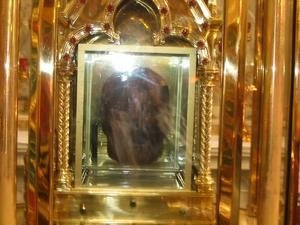
The head of the Saint, preserved in Drogheda Cathedral.

Thursday, September 25, 2014

Saint OLIVER PLUNKET, Archbishop, on the Scaffold, 1681

A REPROVER OF SIN

Biography


"I WAS brought to the bar here after six months' imprisonment for a crime for which before I was arraigned in Ireland; a fact almost without precedent in five hundred years. Five weeks were allowed me to bring over my records and witnesses, which, owing to many difficulties, was insufficient. I asked for five days more. This was refused, and I was exposed, with my hands tied, as it were, to these merciless perjurers. You see what position I am in, and you have heard the protestations of my innocency, and I hope you will believe the words of a dying man. In support of my credit I assure you that I was offered my life if I would accuse other conspirators, but as I know of none I could not. I admit that I endeavoured to establish a proper discipline among the clergy according to my duty, and you see how I am rewarded. By false oaths they have brought me to this untimely death. But this wicked act, being a defect of person, ought not to reflect on the Order of St. Francis or on the Roman Catholic clergy. There was a Judas among the Apostles, and a Nicholas among the seven deacons, and as St. Stephen, the holy deacon, prayed for his enemies, so do I."

And so he went to his reward.

"Them that sin reprove before all, that the rest may have fear."—1 TIM. iv. 20.

Wednesday, September 24, 2014

Blessed EVERARD HANSE, Priest, 1581

A MARTYR'S LEGACIES

Biography

" BROTHER, I pray you be careful of my parents, see them instructed in the way of truth, so that you be careful for your own state also. Give thanks to God for all that He hath sent. Cast not yourself into danger wilfully, but pray God, when occasion is offered, to take it with patience. The comforts at the present time are unspeakable, the dignity too high for a sinner, but God is merciful. Bestow my things you find ungiven away on my poor kinsfolk. A pair of pantoffles I leave with M. N. for my mother. Twenty shillings I would have you bestow on them for me, if you can make so much conveniently ; some I have left with M. N. I owe ten shillings and two shillings. I pray you see it paid. M. N. will let you understand how and to whom. If you want money to discharge it, send to my friends, you know where and to whom. ' Summa Conciliorum (see last para for this link),' I pray you restore to M. B.: the other books, you know to whom. Have me commended to my friends. Let them think I will not forget them. The day and the hour of my birth is at hand, and my Master saith, 'Tolle crucem tuam et sequere Mei Vale in Domino."

" Well done, thou good and faithful servant, because thou hast been faithful over a few things, I will place thee over many things. Enter thou into the joy of thy Lord."—MATT. XXV. 23.

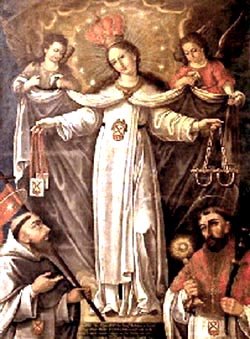
Feast of Our Lady of Ransom


a double major, commemorates the foundation of the Mercedarians.
On 10 August, 1223, the Mercedarian Order was legally constituted at Barcelona by King James of Aragon and was approved by Gregory IX on 17 January, 1235. The Mercedarians celebrated their institution on the Sunday nearest to 1 Aug. (on which date in the year 1233 the Blessed Virgin was believed to have shown St. Peter Nolasco the white habit of the order), and this custom was approved by the Congregation of Rites on 4 April, 1615 (Anal. Juris Pont., VII, 136). But the calendar of the Spanish Mercedarians of 1644 has it on 1 Aug., double. Proper lessons were approved on 30 April, 1616. The feast was granted to Spain (Sunday nearest to 1 Aug.) on 15 Feb., 1680; to France, 4 Dec., 1690. On 22 Feb., 1696, it was extended to the entire Latin Church, and the date changed to 24 September. The Mercedarians keep this feast as a double of the first class, with a vigil, privileged octave, and proper Office under the title: "Solemnitas Descensionis B. Mariæ V. de Mercede". Our Lady of Ransom is the principal patron of Barcelona; the proper Office was extended to Barcelona (1868) and to all Spain (second class, 1883). Sicily, which had suffered so much from the Saracens, took up the old date of the feast (Sunday nearest to 1 Aug.) by permission of the Congregation of Rites, 31 Aug., 1805 (double major), Apparition of Our Lady to St. Peter Nolasco in the choir of Barcelona, on the Sunday after 24 Sept.

In England the devotion to Our Lady of Ransom was revived in modern times to obtain the rescue of England as Our Lady's Dowry.

Feast of Our Lady of Walsingham

Walsingham was the most celebrated of all the English sanctuaries of Our Lady. So great was the veneration in which it was held that it was called the "Holy Land of Walsingham". About 1061 a little chapel, similar to that of the Holy House of Nazareth (not yet translated to Loreto) and dedicated to the Annunciation, was built here by Rychold (Recholdis) de Faverches, a rich widow, in consequence, it is said, of an injunction received from Our Lady. Within the chapel was a wooden image of the Blessed Virgin and Child. Pilgrims flocked from all parts of England and from the Continent to this sanctuary, and its priory became one of the richest in the world. Among the royal and noble pilgrims were: Henry III, who came in 1248; Edward I in 1272 (?) and 1296; Edward II in 1315; his consort, Isabella of France, in 1332; Edward III in 1361; Edward IV and his queen in 1469; Henry VII in 1487; Henry VIII in 1511, walking barefoot from Barsham Hall, on which occasion he presented Our Lady with a necklace of great value; and finally Queen Catherine of Aragon in 1514. About 1538 the venerated image was brought to London with that of Our Lady of Ipswich, and both were publicly burnt at Chelsea in presence of Cromwell. Fifteen of the canons of Walsingham were condemned for high treason; five were executed. All the jewels and treasures left by the piety of the faithful found their way into Henry VIII's coffers  Source
.

Tuesday, September 23, 2014

Saint JOHN WALL, OSF, 1679

THE NARROW WAY

BORN of a Lancashire gentleman's family, he received the habit of St. Francis at Douay in 1651, being then thirty-two years of age. He entered on the English Mission, 1656, and laboured successfully for twelve years. At the breaking out of the Oates Plot he was apprehended, and, refusing to take the oath of allegiance, was imprisoned in Worcester gaol. Of his sentiments then he writes: " Imprisonment in these times, when none can send to their friends or their friends come to them, is the best means to teach us how to put our confidence in God alone in all things, and then He will make His promise good 'that all things shall be added unto us' (Luke xii. 31), which chapter, if every one would read and made good use of, a prison would be better than a palace, and a confinement for religion and a good conscience' sake more pleasant than all the liberties the world could afford. As for my own part, God give me His grace and all faithful Christians their prayers; I am happy enough. We all ought to follow the narrow way, though there be many difficulties in it. It is an easy thing to run the blind way of liberty, but God deliver us from all broad, sweet ways."

" How narrow is the gate and straight the way that leadeth to life, and few there are that find it."—MATT. vii. 14.

Monday, September 22, 2014

Sainthttp://drbo.org/x/d?b=drl&bk=54&ch=10&l=1#x, Jesuit, 1628

LOWLY BUT BOLD

HE is described as being, like St. Paul, of mean presence, but of great innocency of life, and so zealous, witty, and fervent that his eagerness to dispute with heretics, had he not been restrained, would have brought him too soon into danger of death. A Protestant gentleman, thinking from his appearance he might be easily befooled, tried to jest upon him, but his retorts were so sharp that the gentleman swore that where he thought he had met a mere simpleton he had found a foolish scholar or a learned fool. He had such great power in freeing possessed persons, during his fifteen years of priestly labour, first as a secular then as a Jesuit, that at his last trial the judge pleaded for his death as too dangerous a seducer to be set at liberty. Dr. Bridgman, Bishop of Chester, before whom he was once brought at supper-time in Lent, excused himself for eating flesh, as being dispensed on account of- weakness. " But who dispenses your lusty ministers there, who have no such need, and all eat flesh?" As divers ministers together attacked him, he said to the Bishop, "Turn all your dogs at once against me, and let us have a loose bait."

" Now I, Paul, beseech you by the mildness and modesty of Christ, who in presence indeed am lowly among you but being absent am bold towards you."—2 COR. x. i

Sunday, September 21, 2014

Saint EDMUND ARROWSMITH, Jesuit, 1628

A HOLY YOUTH

His family were great sufferers for the faith. His maternal grandfather, Mr. Nicholas Gerard, being unable to move with the gout, was carried to the Protestant Church and placed close to the minister, but he sang Psalms in Latin so loud that the minister was inaudible, and he had to be removed. His parents and their household were driven, tied two and two, to Lancaster gaol, the four youngest children, of which Edmund was one, being left homeless and unclad until some charitable neighbours took compassion on them. After some years, to ease his now widowed mother of her burden^ a venerable priest took charge of Edmund. As the boy went to school, about a mile distant, his daily practice was to recite with his companions the little hours of Our Lady's Office, and on his way back the Vespers and Compline. After his return home he would withdraw to his oratory and there perform his customary devotions of the Jesus Psalter, the Seven Psalms, &c, and so engaging were his tempef and manners that he won the affection of even the Protestant schoolmaster. His priestly studies, though often interrupted by his bad. health, were completed at Douay, whence he went on the English Mission, 1613.

"When he was yet a boy he began to seek the God of his father David."—2 PARAL. xxxiv.3

Saturday, September 20, 2014

Blessed JOHN DUCKETT, Priest, 1644

TO SAVE OTHERS

HE was taken, in company with two Catholic laymen, as he was going to baptize two children on the Feast of the Visitation, July 2. His captors, the Parliament soldiers, carried him before a committee of the Sequestrators at Sunderland. He declined to answer as to his priesthood and demanded proof, but was committed to prison by reason of the Holy oils and books found on h
im. Again examined, and again refusing to inculpate himself, he was threatened with lighted matches placed between his fingers to make him confess what he was. This availing nothing he was sent back to prison. After an hour he was again called, and found his two companions on the point of being shipped and sent away, merely because he would not confess who he was. " Seeing this," he says, " and also fearing that the Catholics of the neighbourhood who knew me might suffer, and especially those with whom I lived, I confessed myself to free them and the country." His self-sacrifice was successful, and seemed an inspiration from Heaven. No more inquiry was made after his friends, but Father Duckett was sent up to London in company with Father Corby, a Jesuit, who was taken in these parts as he was going up to the altar to say Mass.

" If therefore ye seek Me, let these go their way."—JOHN xviii. 8.

Friday, September 19, 2014

Blessed RICHARD HURST, Layman, 1628

PRAYERS FOR THE DEAD

THIS is his last letter to his confessor when about to suffer : " Now I take my last leave ; now I am dying, and am as willing to die as ever I was to live, I thank my Lord and Saviour, who I trust will never fail me. I have comfort in Christ Jesus and His Blessed Mother, my good angel, and all the blessed Saints, and in the valiant and triumphant martyr, B. Arrowsmith, who is gone before me. How I have been used you will hear, and likewise what I had offered me if I would have taken the oath. I hope my friends will truly understand that my greatest desire is to suffer, and I would I had as many lives to offer as I have committed sins. Now, dear Sir, prepare yourself also to suffer, and animate your ghostly children in suffering. Once again, I desire you to say and to procure some Masses for my sinful soul, and if it please God to receive me into His kingdom, I shall not be unmindful of you and of all my good friends. I pray you remember my poor children, and encourage my friends about my debts which my chief worldly care is to satisfy. Once again, adieu. I desire to be dissolved, and to be with Christ Jesus:"

" He sent twelve thousand drachms of silver for sacrifice to be offered for the sins of the dead, thinking well and religiously concerning the Resurrection."—2 MACH. xii. 43.

Thursday, September 18, 2014

Blessed RICHARD HURST, Layman, 1628

STRONGER THAN DEATH

HE wrote before his death three letters to his confessor. The first is as follows : " I received your letter with news of death, at which I am not much dismayed, I thank my Lord and Saviour; the more malicious my enemies the greater my comfort, for I do constantly believe that my religion is the cause of their malice, and my greatest desire is to offer my blood in so good a cause. And although my flesh be timorous and fearful, I yet find great comfort in spirit, in casting myself upon my sweet Saviour with a most fervent love, when I consider what He hath done and suffered for me; and I had rather die a thousand deaths than possess a kingdom and live in mortal sin ; for there is nothing so hateful to me as sin, and that only for the love of my Saviour. I do most constantly believe that He hath afflicted me to save me, and I trust I shall die truly humbled, for the which I desire your good prayers, that I may persevere to the end ; for of myself I can do nothing without His grace." He left behind him six little children, and his wife with child.

" Lord, Thou knowest all things, Thou knowest that I love Thee."—JOHN xxi. 17

Wednesday, September 17, 2014

Saint AMBROSE BARLOW, OSB, 1641

ROMANS THE ONLY PRIESTS

HE was led to Lancaster gaol amidst a jeering mob, but was so weak that he had to be held on the horse's back. In prison he wonderfully recovered his health, and refused every offer of escape or of petitions for his life. At his trial, after four months' imprisonment, the judge asked him what he thought of the laws by which priests were put to death. "All laws," he answered, " made against Catholics on account of their religion are unjust and impious, and that especially which condemns priests to suffer as traitors merely because they are Roman—that is, true priests. For there are no other priests but the Roman, and if they be destroyed, what must become of the Divine law when none remain to preach God's law and administer the Sacraments ? And if, my Lord, in consequence of so unjust a law, you condemn me to die, you would send me to Heaven and yourself to Hell." He was sentenced, and brought out to suffer on Friday, September 10, carrying a wooden cross which he had made. He told the ministers who pestered him that he had something else to do than to hearken to their fooleries, and saying the Miserere he went to Heaven, September 10, 1641.

"But I chose Jerusalem that my name might be there, and I chose David to set him over my people."—2 PARAL. vi. 6.

Tuesday, September 16, 2014

Saint AMBROSE BARLOW, OSB, 1641

HORROR OF SCANDAL

SOME months before his last apprehension, for he was several times a prisoner, he heard that some persons, dear to him as his own soul, were bent upon doing something very wicked, and which was Hke to be the ruin of many souls. The news of this scandal so strongly on a sudden affected him that he was seized with a fit of dead palsy, which deprived him of the use of one side and put his life in danger. What added very much to his cross was the fear lest his poor children whom he had begotten in Christ should now be left destitute of spiritual assistance. Moreover, he had the additional affliction that, while his convulsions and pains seemed to have brought him to death's door, no priest could be found to administer the Holy Sacraments to him. In this anguish God was pleased to comfort him, and he made an act of complete conformity to God's will, preferring that entire resignation to the use of the Sacraments or to martyrdom itself. While in these dispositions a Jesuit father arrived to assist him, as he himself had twelve years before exercised the same charity to B. Arrowsmith when in prison, at which time that confessor of Christ had foretold that he must be the next to follow.

" Who is weak and I am not weak ? who is scandalised and I am not on fire?."—2 COR.xi.29.

Monday, September 15, 2014

Saint AMBROSE BARLOW, OSB, 1641

THE PRIMITIVE CHURCH

ON the eves before the principal festivals of the year, whilst Father Barlow was in health, the Catholics resorted to him from distant places and passed the night, after the manner of the primitive Church, in watching, prayer, and spiritual colloquies, whilst, for his part, he was employed almost all the night hearing confessions. On the next day he treated them all with a dinner, when he and some of the more honourable of his flock served them that were poor, and waited upon them, and then dined off their leavings. When he sent them home he gave each of them a groat in alms, and when all had dined he distributed what remained to the poor of the parish. His zeal had made him as well known in all that neighbourhood as the very parson of the parish. Some reprehended him for going about so publicly ; to whom he replied, " Let them fear that have anything to lose, which they are unwilling to part with." This was indeed not his case, as he had set his heart upon nothing in this world, and was even desirous to lay down his life for God's cause. Nor could he be persuaded to retire further from danger, desiring, were it God's will, to shed his blood at Lancaster.

" And the multitude of believers had but one heart and one soul ... all things were common unto them."—ACTS iv. 32.

Sunday, September 14, 2014

Saint AMBROSE BARLOW, OSB, 1641

SEPARATED UNTO THE GOSPEL

Biography

HE began his labours in his native county Lancashire, aged thirty, about 1615. There he boarded with an honest country farmer, which he preferred to living with great families, though desired by many, that the poor might always have access to him night or day. To them he devoted his labours and imparted alms, spiritual and temporal, according to his ability. He would never have a servant till forced by sickness ; never would have a horse, but made his pastoral visits always on foot. His apparel was mean ; neither would he ever wear a sword or carry a watch. He allowed himself no manner of play or pastime, and avoided all superfluous talk or conversation. He was never idle, but was always either praying, studying, preaching, administering the Sacraments, or sometimes as a diversion painting pictures of Christ or His Blessed Mother, whose beads he recited daily. He set free many possessed persons ; he had great talent in composing differences and reconciling those at variance, and was consulted as an oracle by the neighbouring Catholics in all their difficulties. He feared no dangers, and when God's honour or the salvation of souls called him forth, would face his enemies even at noonday, and pass through them unhurt.

" Paul, a servant of Jesus Christ, called to be an apostle, separated unto the Gospel of God." —ROM. i. 1.

Saturday, September 13, 2014

Blessed ADRIAN FORTESCUE, Layman

MARTYR'S MAXIMS (2)

BE not partial for favour, lucre, or malice, but according to truth, equity, justice, and reason.

Be pitiful to poor folk and help them to thy power, for then thou shalt greatly please God.

Give fair language to all persons, and especially to the poor and needy.

Also be diligent in giving of alms.

In prosperity be meek of heart, and in adversity patient.

And pray continually to God that you may do what is His pleasure.

Also apply diligently the co-operations of the Holy Ghost whatever thou hast therein to do.

Pray for perseverance.

Continue in dread, and ever have God before thine eyes.

Renew every day thy good purpose.

What thou hast to do, do it diligently.

'Stablish thyself always in well-doing.

If by chance you fall into sin, despair not, and if you keep these precepts, the Holy Ghost will strengthen thee in all other things necessary, and thus doing you shall be with Christ in Heaven, to whom be glory, laud, honour, and praise everlasting.

" She conducted the just through the right ways and showed him the kingdom of God, and gave him the knowledge of holy things."— WlS. x. 10.

Friday, September 12, 2014

The Lancashire Martyrs and dates of execution

Blessed James Bell - 1584
Blessed John Finch - 1584
Blessed Robert Nutter - 1600
Blessed Edward Thwing - 1600
Blessed Thurstan Hunt - 1601
Blessed Robert Middleton - 1601
Venerable Lawrence Bailey - 1604
Blessed John Thules - 1616
Blessed Roger Wrenno - 1616
Saint Edmund Arrowsmith - 1628
Blessed Richard, Hurst - 1628
Saint Ambrose Barlow - 1641
Blessed John Woodcock - 1646
Blessed Thomas Whittaker - 1646
Blessed Edward Bamber - 1646

And these men of Lancashire, Westmorland and Cumberland who were executed outside the county and beatified in 1929 or 1987 and some canonised in 1970

Blessed Thomas Cottam - 1582
Blessed Thomas Sprott - 1600
Blessed John Nutter - 1584
Saint John Rigby - 1600
Blessed James Duckett - 1602
Blessed George Haydock - 1584
Blessed Thomas Somers - 1610
Blessed William Marsden - 1586
Blessed Thomas Tunstall - 1616
Blessed John Sandys - 1586
Blessed William Ward - 1641
Blessed George Beesley - 1591
Blessed John Duckett - 1644
Blessed John Mason - 1591
Blessed John Pickering - 1679
Saint John Boste - 1594
Saint John Wall - 1679
Blessed Christopher Robinson - 1597
Saint John Plessington - 1679

Blessed ADRIAN FORTESCUE, Layman

A MARTYR'S MAXIMS (1)

Biography


ABOVE all things love God with all thy heart.


Desire His honour more than the health of thine own soul.

Take heed with all diligence to purge and cleanse thy mind with oft Confession, and raise thy desire or lust from earthly things.


Be you houseled (that is receive Holy Communion) with entire devotion.

Repute not thyself better than any other person, be they never so great sinners, but rather judge and esteem yourself most simplest.

Judge the best.

Use much silence, but when thou needs must speak.

Delight not in familiarity of persons unknown to thee.

Be solitary as much as is convenient with thine estate.

Banish from thee all judging and detraction, and especially from thy tongue.

Pray often.

Also enforce thee to set thy house at quietness.

Resort to God every hour.

Advance not thy words or deeds by any pride.

Be not too much familiar, but show a serious and prudent countenance with gentleness.

Show before all people a good example of virtues.

" The Wisdom from above is first chaste."— JAS. iii. 17.

Canonised Martyrs under Henry VIII

St John Houghton 1535
St Robert Lawrence 1535
St Augustine Webster 1535
St Richard Reynolds 1535
St John Fisher 1535
St Thomas More 1535
St John Stone 1539

Thursday, September 11, 2014

ROBERT DYMOKE, Layman., 1580

HEREDITARY CHAMPION OF ENGLAND

Biography


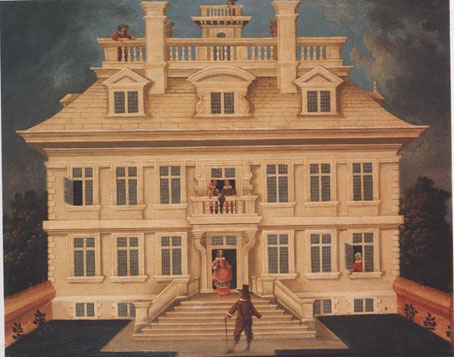
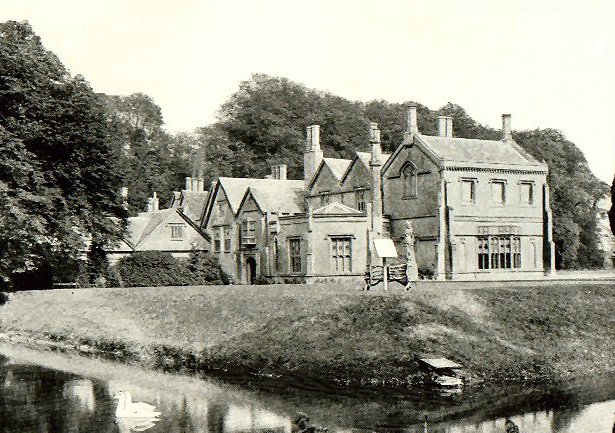
SCRIVELSBY COURT (demolished 1961), Lincolnshire,


the home of the Dymokes, was one of the centres of the Rising in that county. The " articles of grievance " devised by the insurgents were drawn up by the Dymokes. Robert had so far conformed as to attend the Protestant service, while he harboured a priest, B. Kirkman, in his house disguised as a schoolmaster to his sons. This act of hospitality, with the risks it involved, seems to have procured for him the grace of complete conversion. On July 24, 1580, Robert and his wife, Lady Bridget, were indicted for hearing Mass and for non-attendance at the Protestant service. Though helplessly paralysed, he was carried to Lincoln, and in a miserable prison there fell dangerously ill. Even when dying he was not left in peace. " They come," writes Father Persons, "when he is wrestling with the pangs of death. Even then the ministers do not permit him to die, as he desires, a Catholic death. They urge him to pray such sorry prayers of their own making as in health he contemned, in sickness with open voice he rejected, and now dumb and half dead, by his countenance, by signs and tokens, and by gesture of his body, he did utterly contemn and abhor."

" Who by faith conquered kingdoms, wrought justice, obtained promises, stopped the mouths of lions."—HEB. xi. 33.

Wednesday, September 10, 2014

Bishop GILBERT BOURNE OF BATH AND WELLS, 1569

PRESSED OUT OF MEASURE

Biography and Hhis Diocese

HE held, besides his sees at Elizabeth's accession, the important secular office of President of the Council of Wales. From this he was removed by the Queen in furtherance of her plan of depriving all Catholics of positions of trust. On his refusal to consecrate Parker, and again to take the oath of Supremacy, he was sent to the Tower, June 18, 1560. There he remained till the plague broke out in 1563, when he was quartered on Nicolas Bullingham, Bishop intrusive of Lincoln. He died in charge of Dr. Carew, Dean of Exeter, who at Elizabeth's coronation had sung the Mass without elevating either the Sacred Host or chalice.


Bishops in charge of these Protestant dignitaries were to be kept in safe custody, to have their diet alone in their chamber, and that in no superfluity. They were to see only their attendant, never to take the air save accompanied with his custodian. They were to have sound books lent to them, and be persuaded to hear sermons, and attend the Protestant services. Thus deprived of Mass, the Sacrament, Catholic books, or the sight of a Catholic, wearied by heretical arguments, and worn by the continual pressure of their heretical keepers, the confessors bore witness till death.

" We would not have you ignorant, brethren, of our tribulation. We were pressed out of measure, so that we were weary even of life."— 2 COR. 1. 8.

Tuesday, September 09, 2014

Venerable RALPH CORBY, SJ and Venerable JOHN DUCKETT, Priest, 1644

THE KISS OF PEACE

HAVING each refused to be spared at the cost of the other's life, they were sentenced to death, and returned with joy to prison, there to wait. V. Corby wrote: " For that holy and happy Saturday (September 7), which is the vigil of her glorious Nativity, by whose holy intercession I hope to be born again to a new and everlasting life." Their last day and the whole ensuing night was spent in prayer, fasting, watching, and in spiritual conferences with those who came to confess and to hear their last Mass. Amongst these were the Duchess of Guise and the French envoy. Father Corby in his last Mass appeared to be overwhelmed with an agony of sadness and fear. At length the cloud passed, and his joy returned. They went out to suffer with their tonsures shaved, the one in his Jesuit's habit, the other in his priest's cassock. At the gallows Father Duckett made no speech, but told an heretical minister that he had not come hither to be taught his religion, but to die for it. After a short discourse from Father Corby, the two confessors turned to each other. Together they had been arrested, supported each other by their mutual courage and self-sacrifice, and with a last most loving embrace they together received their eternal crown.

" Salute one another in a holy kiss; all the saints salute you."—2 COR. xiii. 12.

Monday, September 08, 2014

Venerable RALPH CORBY, Jesuit and Venerable JOHN DUCKETT, Priest, 1644

HOLY RIVALRY

Biographies of Ralph Corby and John Duckett

RALPH CORBY, alias Darlington, was born near Dublin of English parents, natives of Durham, whothat both parents and children entered into religion : the father and his three sons into the Society of Jesus, the mother and her daughters into the Order of St. Benedict. After twelve years' hard work, notwithstanding continuous ill-health, among the poorer Catholics in Durham, he was arrested and sent up to London with Father Duckett. They were escorted from Westminster to Newgate by a company of Parliament soldiers, with a captain at their head, beating drums and firing off their muskets through the crowded streets, as if they had been the enemy's generals taken in war as in the old Roman battles. In prison the life of one of them could have been saved by an exchange made for a prisoner in the hand of the Emperor of Germany. The offer was first made to Father Corby, who declined it on the ground that Father Duckett, being younger, could do more work than himself; but he in his turn refused it with thanks, as Father Corby's life, on account of his experience, was of greater value.
had gone over to Ireland for the free exercise of their religion. The piety of the family is sufficiently attested by the fact

" Behold what manner of charity the Father hath bestowed upon us."—1 JOHN iii. 1.

Sunday, September 07, 2014

+ Blessed JOHN DUCKETT, Priest, 1644

THE CONTEMPLATIVE WAY

Biography

OF an old Yorkshire family, he entered Douay and was so much addicted, the Diary says, to mental prayer, that while he was yet a student he was known to pass whole nights in those heavenly communications. Being both humble and discreet, before going on the English Mission he conferred at Paris with some very spiritual persons on his way of prayer, of which they approved, though what passed between his soul and God was so sublime that they owned it was above their comprehensions. For further security against delusions, to which contempla-tives are often exposed, he placed himself under the direction of the Prior of the Carthusians at Newport (for the earlier history of this house), and spent two months in preparing himself by spiritual exercises for the conversion of souls. His mission was in the diocese of Durham, where he had been about a year when he was arrested, tried, and condemned. On hearing his sentence his countenance, which was naturally pale, became in a manner angelical, and his cheeks a beautiful colour, which continued till death. That this expression of outward joy proceeded from his heart, we learn from his letters. " Ever since I was a priest," he writes, " I did much fear to live, but nothing fear to die."

" This is my rest for ever and ever ; here will I dwell, for I have chosen it."—Ps. cxxxi. 14.

One Frances DRURY

was prosecuted in 1584 for hearing Catholic Mass said by Father Monford Scott on this day 1583.

Saturday, September 06, 2014

Saint EDWARD AMBROSE BARLOW, Benedictine, 1641

AN EASTER OFFERING

Biography


HE was beginning to recover from his illness, but was still very weak, when he was apprehended on Easter Day 1641. A neighbouring minister proposed to his congregation that, instead of their service, they should show their zeal by capturing the noted popish priest, whom they would surely now find in the midst of his flock, but would lose when church time was over. Some four hundred went therefore with clubs and swords, the parson marching at their head in his surplice. Father Barlow had finished Mass, and was making a discourse to his people on the subject of patience, when the house was found to be surrounded by armed men. He refused to hide himself in any of the secret places provided in the house for that purpose, or leave his sheep, as he said, to the mercy of the wolves. He exhorted them to constancy, and reminded them that these light and momentary tribulations worked an eternal weight of glory, and telling them that he was ready to offer all things for Christ, he bid them open the door. The mob rushed in, shouting, "Where is Barlow? he is the man we want," and laying hands on him they secured him and let the rest go, upon giving caution for their appearance. He suffered at Lancaster, September 10, 1641.


"For Christ our Pasch is sacrificed."—1 COR.v. 7.

Friday, September 05, 2014

Bishop EDMUND BONNER OF LONDON, 1569

FAITHFUL IN THE END

Biography


HE was a native of Worcestershire, educated at Broadgates Hall, Oxford (very long pdf file, page 50 onwards for the history of Broadgates Hall, 102 onwards for the times of Bishop Bonner), became chaplain to Henry VIII, was very zealous in promoting the divorce, and behaved, as he tells us himself, insolently to the Pope. He accepted the Bishopric of London from the King, and was consecrated April 4, 1540, but never received the necessary Bull from Rome. For refusing to accept Edward VI's changes in religion he was deposed and imprisoned. He was set free by Mary, and canonically reinstated. Under Elizabeth he was the first to whom the oath was proffered, and had the honour of being the first to refuse it. He was specially detested by the Protestants on account of his supposed severity to heretics, but Mr. Gairdner expressly states that to the prisoners in his hands he was kind, gentle, and considerate, and always strove by gentle suasion to reconcile them to the Church before handing them over to the civil power. When ordered by the Council to remove the service of the Mass and the Divine office from St. Paul's, the one church where the Catholic rites still existed, he replied, " I possess three things—soul, body, and property. Of the two last you can dispose at your pleasure."


" Restore unto me the joy of Thy salvation, and strengthen me with a perfect spirit."—Ps. l.14.

Thursday, September 04, 2014

Blessed THOMAS ABEL, Priest to Blessed JOHN FOREST, Franciscan

PERSEVERANCE

"COUNT not your tortures, my son, for that is to add pain to pain; but rather, as St. Paul says, ' Reckon the sufferings of this time not worthy to be compared with the glory to come.' Romans viii, 16.To which may well be added what the Prophet says to our Lord : ' For a thousand years in Thy sight are as yesterday which is past.' (in fact, Psalm 89:4) If you bear patiently the tortures that are inflicted on you, doubt not of your reward. O blessed and thrice happy reward which God gives to those who fear Him ; hence we pray, ' Lord, reward Thy servant.' But only on the condition, ' I have kept Thy words.' If, therefore, there is a reward for keeping the words of the Lord, keep them, my son. But you will ask, 'How long?' To the end! For our Saviour says, ' He that shall endure unto the end, he shall be saved.' Therefore, neither the tortures of thirty-seven days, nor of a thousand years, but the last end will crown your combat. Think you, my son, that we shall run together, and drink of the same chalice ? A greater combat awaits for me ; but for you lighter sufferings remain. Whatever they be, act manfully, our Lord supporting you. Farewell."

" He that shall endure to the end, he shall be saved."—MARK xiii. 13.

Wednesday, September 03, 2014

Blessed THOMAS ABEL, Priest to Blessed JOHN FOREST, OSF

HOW LONG, O LORD?

Biographies of Thomas Abel and John Forest

"ALTHOUGH human nature is terrified by the intensity of tortures, yet our faith demands and requires us to bear them. I said, ' My foot is moved because Thou hast turned away Thy face from me. Thou turnest away Thy face from me, and I became troubled ; troubled, I say, because the pain of the tortures which I desire is prolonged, and at the same time I am humbled ; humbled, and not raised up, because not drawn to my Saviour ; not drawn, because I am burdened with the weight of my sins* burdened and not refreshed by Him. What, then, profits my condemnation, if there be longer to wait ? Wherefore, I ask ? Because you have not availingly implored the mercy of God. For I know how much the prayer of the just man weighs before God. Because with the Lord there is mercy, and with Him plentiful redemption. In Thee have our fathers hoped; they have hoped, and Thou hast delivered them for the sake of David, Thy servant. Why, then, is there not an end put to these tortures ? I have now suffered seven and thirty days, and I find no rest. But my hope is that we shall die together by the same punishment."

" He that shall endure to the end, he shall be saved."—MARK xiii. 13.

Tuesday, September 02, 2014

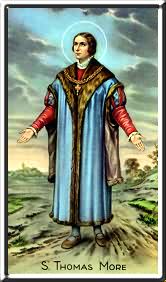
Saint THOMAS MORE, Layman, 1535

TIME AND ETERNITY

Biography


WHEN his wife came to see him she reproached him roundly for preferring to stay among the rats and mice in a close, filthy prison, when he might be enjoying his liberty, the goodwill of the King, and the company of his family in his " right fair" house at Chelsea. " I muse what a God's name you mean here still thus fondly to tarry," she cried. Sir Thomas said cheerfully, "I pray thee, good Mistress Alice, tell me one thing : is not this house as near Heaven as mine own?" " Tilly vally, tilly vally," quoth she, in her homely fashion. " Bone Deus, man, will this gear never be left ? " " Well, then," quoth he, " I see not why I should much joy in my house, when, if I arose after being seven years dead, the new owner would bid me get out of doors, or why should I like a house so soon forgetful of his master? How long do you think we may live and enjoy it ? " " Some twenty years," said she. " Truly," replied he, "if you had said some thousand years it had been somewhat; and yet he were a bad merchant that would risk Eternity for a thousand years ; how much the rather, if we are not sure to enjoy it one day to an end."


"One day with the Lord is as a thousand years, and a thousand years as one day."— 2 PET. iii. 8.

Monday, September 01, 2014

Venerable JOHN GOODMAN, Priest, 1645

A LIFE OFFERING FOR THE PEOPLE

Biography

OF Bangor, Wales, and Oxford University, he became a Protestant minister, but being dissatisfied with the religion was received into the Church abroad, and returned as a priest on the English Mission. His zeal for souls was soon well known, and in 1635 and again in 1639 he was apprehended, but each time discharged. In 1640 he was again taken, and tried, and condemned. Charles I, however, interfered, and changed the death sentence into that of perpetual banishment, or imprisonment, on the ground that none had been condemned fot merely being a priest, nor had Goodman been before condemned for perverting the people in their belief. To this message of the King the Lords and Commons replied by a vehement remonstrance, urging the sentence of death to be carried out. Charles made answer that, being pressed by both Houses, he would leave the case to their decision, and so washed his hands of the matter. Goodman, however, petitioned the King that, since the suspension of his execution caused such discontent, the law might take its course. In consequence, apparently, of this magnanimity, he was allowed to linger in prison, and died in Newgate 1645.

"And he said, Take me up and cast me into the sea, and the sea shall be calm to you ; for I know that for my sake this great tempest is upon you."—JONAS i. 12.

Sunday, August 31, 2014

Venerable Thomas Felton, Layman, 1588

THE TABERNACLE OF KORE

A MARTYR himself and the son of a martyr, his father having suffered for putting up St. Pius V's Bull of excommunication, he was apprehended as a suspected Papist for the third time, though but a layman, when only twenty years of age. Tortured in the "Little Ease," starved, hanged up by the hands till the blood sprang from his finger ends, he remained steadfast. Upon a Sunday he was violently taken by certain officers and carried betwixt two, fast bound in a chair, into the chapel at Bridewell to their service. He, having his hands at first at liberty, stopped his ears with his fingers that he might not hear what the minister said. Then they bound down his hands also to the chair ; but being set down to the ground, bound in the manner aforesaid, he stamped with his feet, and made that noise with his mouth, shouting and hallowing, and crying oftentimes, " Jesus, Jesus," that the minister's voice could not be heard. Asked by the judge if he acknowledged the Queen's supremacy, he made answer that " he had read divers chronicles, but never read that God ordained a woman should be supreme head of the Church." For this speech he was condemned, and hung the next day near Hounslow, Middlesex.

" Depart from the tents of these wicked men, and touch nothing of theirs, lest you be involved in their sins."—NUM. xvi. 26

Saturday, August 30, 2014

+ Saint MARGARET WARD, 1588

VISITING THE PRISONER
Biography

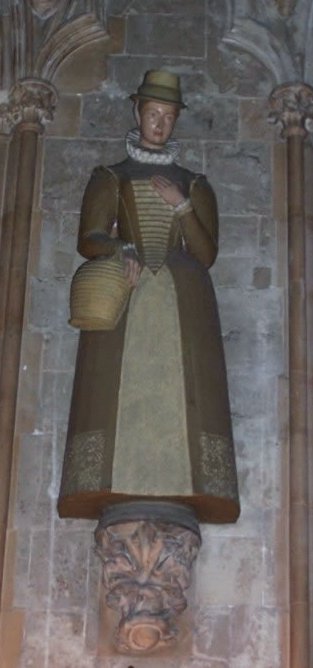
WILLIAM WATSON, a secular priest, being apprehended, through force of torment went to the Protestant Church once. Struck with remorse in the midst of the Protestant congregation, he repaired the scandal he had there given by recanting his conformity, and declaring that theirs was not the service of God, but was in truth the service of the devil. For this he was again imprisoned, and was continually plied with threats and promises to urge him to go again to church. The Catholics feared for his constancy, but dared not, for their own safety, approach him, till a gentlewoman, Margaret Ward, determined to make the attempt. Disguised and carrying a basket of provisions, she for a month visited the prison, being always closely searched. At length she managed to convey him a cord, and with this he effected his. escape ; but in his haste and danger he left the cord hanging from the window of his prison. Margaret, being his only visitor, was therefore apprehended, hung up by the hands, and cruelly scourged. On her trial she admitted her part in the prisoner's escape, and rejoiced " in having delivered an innocent lamb from the hands of bloody wolves." Offered her pardon if she would go to church, she refused, and was executed, showing to the end great constancy, August 30, Tyburn,

" I was in prison, and you visited me."— MATT. XXV. 36.

Friday, August 29, 2014

+ Blessed RICHARD HERST, Layman, 1628

MURDER FOR EXAMPLE

Biography

A CONVICTED recusant, he was ploughing his field when one Dewhurst came to serve him with a warrant. Herst fled, and Dewhurst, following in pursuit, received a blow from Herst's maid, and afterwards in the heat of the pursuit fell and broke his leg. From that wound in the leg he died, yet Herst, who had never been within thirty yards of him, was charged with his death. Herst's pardon was offered him if he would take the oath, but he refused, and he declined also to go to church, so he was trailed there by his legs and much hurt. In the church he stopped his ears, not to hear false doctrine, and, on returning, said, " They have tortured my body, but, thank God, they have not hurt my soul." At his trial at Lancaster, though his innocence of Dewhurst's death was evident, the judge told the jury that he was a recusant, had resisted the Bishop's authority, and that they must find it murder for an example, which was done. At the gallows he said to the hangman, who was bungling with the rope, " Tom, I think I must come and help you." Then, after repeating the holy names of Jesus and Mary, he passed to immortality, Lancaster, August 29.

" Cursed shalt thou be upon the earth, which hath opened her mouth and received the blood of thy brother at thy hand."—GEN. iv. II, 12.

Thursday, August 28, 2014

+ Venerable Edmund Arrowsmith, SJ, 1628

STRIKING THEIR BREASTS
Biography

HE was sentenced at Lancaster for being a priest, a Jesuit, and a persuader of religion, and the judge ordered that he was to be hung at noon, when most men would be at dinner ; but as it fell out the whole place of execution was covered with great multitudes of people of all sorts, ages, sexes, and religions, expecting the end of the tragedy. As he was carried through the castle yard, Father Southworth, his fellow-prisoner under reprieve, appeared at the prison window and received his absolution. He was then bound on the hurdle, with his head towards the horse's tail, " for greater ignominy." Most of his friends were prevented to approach him, and the executioner went before the horse and hurdle with a club in his hand in a kind of barbarous triumph. On the scaffold he refused to save his life by taking the oath, professed that he died for the Catholic faith, and prayed for the conversion of England. His last words, as he was cast off the ladder, were "Bone jesu." Divers Protestants, beholders of this bloody spectacle, wished their souls with his. Others wished they had never come there. Others said it was a barbarous act to use men so for their religion.

"And all the multitude of them that were come together to that sight, and saw the things that were done, returned striking their breasts." —LUKE xxiii. 48.

See also Arrowsmith House.

Wednesday, August 27, 2014

Blessed ROGER CADWALLADOR, Priest, 1610

GLORIFYING GOD

Biography

When he was near his crown he wrote, "Comfort yourselves, my friends, in this that I die in an assurance of salvation ; which, if you truly love me as you ought to do, should please you better than to have me alive a little while among you for your content, and then to die with great uncertainty either to be saved or damned. If this manner of death be shameful, yet not more than my Saviour's was : if it be painful, yet not more than was His. Only have you care to persevere in God's true faith and charity, and then we shall meet again to our greater comfort that shall never end." On the morning of his execution, having spent some five hours in prayer, he took some broth and claret, to make himself strong, he said, like Bishop Fisher, to suffer for God, and dressed himself in a new suit of clothes as his wedding garment. On the scaffold, asked to give his opinion as to the oath, he replied that his opinion mattered little; they should regard rather the sentiments of the Church, for his swearing would neither diminish the Pope's authority nor increase the King's. His constancy under the terrible butchery which attended his end confirmed the faith of the Herefordshire Catholics.

" But let none of you suffer as a murderer or a thief . . . but if as a Christian let him not be ashamed, but let him glorify God in His Name." —1 PET. iv. 15, 16.

Tuesday, August 26, 2014

+ BISHOP THIRLBY OF ELY, 1570 ,

CHEERFUL IN ADVERSITY

Biography

HE was absent on an Embassy in France on Elizabeth's accession. On April 2,1559, he concluded the treaty of Cateau Cambresis, and on his return to England he at once joined the other Bishops in opposition to the Bill of Royal Supremacy. He refused the oath and was deposed July 5,1559, was committed to the Tower June 3, 1560, and endured there the miseries of close and separate confinement until September 1563, when the plague was raging. Elizabeth was then at Windsor Castle, and there was set up, Stowe writes, in the market-place of Windsor a new gallows to hang up all such as came there from London, so that no person might come from London upon pain of hanging without judgment. With this panic at Court the Protestant Bishops were naturally uneasy at receiving orders to house the illustrious prisoners from the town. Thirlby was allotted to Parker, Archbishop of Canterbury, and wrote to him cheerfully that he was an unbidden guest, who, according to the proverb, " wotteth not where to sit," and that he doubted how to travel without danger because of the plague. Yet" need maketh the old wife trot." Dr. Thirlby remained unshaken in Parker's custody for seven years, when, stricken by grave illness, he was released by death.

"According to the multitude of the sorrows of my heart thy comforts have given joy to my soul."—Ps. xciii. 19.

Matthew Parker first protestant Archbishop of Canterbury. It is often said that the term "nosey Parker" comes from him, as he was always making inquiry into business that was not his own.

Feast of Blessed THOMAS PERCY

In November 1569, Thomas Percy, 7th Earl of Northumberland, and Charles Neville, 6th and last Earl of Westmoreland, rebelled against Queen Elizabeth.

In November 1569, Thomas Percy, 7th Earl of Northumberland, and Charles Neville, 6th and last Earl of Westmoreland, rebelled against Queen Elizabeth. Their aim was to reestablish the Catholic Religion. After an initial success in which the earls took Durham, the Rising of the Earls was subdued. In December 1569, both earls fled over the border into Scotland. Westmoreland was alone, Northumberland was accompanied by his wife Anne, a daughter of Henry Beaufort-Somerset, 2nd Earl of Worcester.

Northumberland was soon betrayed by his Scottish hosts and sold to the English. He was subsequently put to trial and executed in York in August 1572. He is considered to be a martyr by the Catholic Church and was officially beatified in the 19th century.

In the Summer of 1570, the earl of Westmoreland, fearing that the same betrayal might also happen to him, left Scotland for Flanders. There he would remain in exile until his death in November 1601. He lived in great poverty and would never see his wife (d. 1593) and four daughters again. The eldest daughter, Margaret Neville (b. 1564), was herself tried in 1594 and sentenced to death for having been found in the company of a Catholic priest. She was, however, pardoned.

Anne, the Countess of Northumberland, also left Scotland and travelled to Flanders. She had given birth to a baby in Old Aberdeen on 11 June 1570 and on 23 August boarded a ship, arriving with her baby at Bruges on 31 August 1570. In Flanders, she was to live in various places, i.a. Malines (1572), Brussels (1574), Liege (1575). She died at Namur on 17 October 1596.

Sir Cuthbert Sharp in his 1840 account of « The Rising in the North ; The 1569 Rebellion » mentions Thomas Percy and his wife as having one son, « Thomas, died young (1560) », and four daughters : « Elizabeth, m. Richard Woodroffe, of Wolley, co. York », « Lucy, m. Sir Edward Stanley, of Eynsham, co. Oxon. », « Jane, m. Lord Henry Seymour », and « Mary, who on the authority of a MS belonging to the English Benedictine Dames (formerly at Bruxelles, now at Winchester) printed in the Catholic Magazine for August 1838, was born on the 11th of June 1570. After the death of the Countess, she came into the low countries, to take possession of what was left her by her mother, but more by her desire to dedicate herself to the service of God, in Holy religion. She became the founder of the Benedictine Dames, at Bruxelles.
» (Sharpe, pp 349-350)

If this is true - Mary, being born on 11 June 1570 and coming to Flanders after the death of her mother in 1596 - it means that her mother must have left her newborn child behind in Scotland when she departed for Flanders in August 1570. However, all sources indicate that she took her child along with her.

The Earl and Countess of Northumberland in November 1569 had left a number of their toddlers behind in their house in Topcliffe in Yorkshire. The rebellious earls, moving in from the North had hoped to take Yorkshire very easily and the Earl and Countess of Northumberland had planned to join their children there. But events turned out otherwise and the rebels fled to Scotland. The children were captured in Topcliffe by their uncle, Henry Percy, the later 8th Earl of Northumberland. To the surprise of his brother, Henry sided with Queen Elizabeth during the rebellion and moved his soldiers against the rebels. He was afterwards rewarded for this loyalty with his brother's earldom. Henry Percy wrote to the Earl of Sussex on 9 January 1570 that « Passing by the younge ladys, I founde them in harde case. They wolde gladly be removyde ». He took them along and raised them within his own family, which soon moved to the Percy castle at Petworth.

Edward Barrington de Fonblanque writes in his book « Annals of the House of Percy » that four daughters survived the 7th Earl of Northumberland. Fonblanque mentions five children (p. 125) : 1. Elizabeth, the eldest (b. 1559), m. Richard Woodruffe of Wolley 2. Thomas (b. 1560, d. 1560) 3. Mary (b. 1563, d. 1643), founder of the Benedictine Dames at Brussels 4. Lucy, m. Sir Edward Stanley of Eynsham 5 . Jane, the youngest daughter, m. Lord Henry Seymour He does not mention a sixth child, born in Old Aberdeen on 11.6.1570, and explicitly states Jane to be « the youngest daughter », while Mary, founder of the English convent in Brussels, is the second daughter, born in 1563.

Fonblanque, who had access to the family archives of the Percies at Syon House and Alnwick Castle, wrote his book in 1887. The genealogical annex of the book, however, gives a totally different version than the text. Here, Mary, second daughter, is stated to have married Sir Thomas Grey of Wark, while there is a sixth child, a second Mary (« Maria »), born on 11.6.1570, who is said to have been the founder of the Brussels Benedictine convent.

In 1902 Gerald Brenan published his « History of the House of Percy ». Brenan complains that he was denied access to the Percy archives : « The present Duke of Northumberland objected to further search among the documentary collection of Alnwick Castle and Sion House as unnecessary » (Brenan, vol. 1, p. XVI), causing Brenan to rely heavily on Fonblanque's Annals, « a work prepared practically under the eye of the late Duke of Northumberland, and largely from original sources. » (ib.) Brenan also mentions two Marys, one married to Thomas Grey of Wark, the other becoming a Benedictine nun in Brussels. However, he notices that something must be wrong there and states that Fonblanque and others often confuse the first « Mary » with the second « Maria ».

I am told that Burke in his older editions also mentions a « Mary » married to Thomas Grey of Wark, as well as a « Maria », founder of the Brussels convent. In later editions, however, Burke omits the first Mary (b. 1563) and retains only the latter, which then becomes Northumberland's youngest daughter.

In September 1591, Charles Paget, an English Catholic exile in Antwerp, writes a letter to the Percy family in London, to announce that the Countess of Northumberland has died and that her youngest daughter Jane is urgently requested to come to Flanders in order to collect her mother's belongings. The Countess only died in 1596. Paget's letter is a ruse to get the youngest daughter, Jane, over to Flanders. Brenan does not know what to make of this letter, thinking that the youngest daughter, Mary, is already in Flanders. He writes : « Paget appears to have forgotten lady Maria. The latter had been her mother's companion and solace from the time, twenty years before, when they left Old Aberdeen together. Lady Mary had surely the best right to what little the Countess left ».

But in reality, lady Mary (b. 1563), had not left Scotland with her mother in 1570. She came to Flanders many years later, as is stated on her epitaph in Brussels : « hic jacet domina Maria Percy filia Thomae Percy Northumbriae comitis, quae fidei confessione in Anglia carceribus diu toleratis in Belgio exul hoc nobilium virginum coenibium sub regula S. Patris Benedicti, propriis amicorumque, ejus instinctu, denariis struxit. Obiit XIII september anno MDCXLII R.I.P. » « Here lies lady Mary Percy, daughter of Thomas Percy, Earl of Northumberland. Because of her faith she suffered imprisonment in England for a long time and came as an exile to the Netherlands where she founded this convent for noble women under the rule of St. Benedict, which convent was founded on her initiative and with her money and that of her friends. She died 13.9.1642. May she rest in peace. »

According to some sources, she was 80 years old when she died, which is correct if she was born in 1562-63. The « long imprisonment in England » which the epitaph mentions (« in Anglia carceribus diu toleratis »), probably refers to the unhappy period of her life that she lived in her uncle's household in Petworth. After her mother's death, Mary Percy in 1599 founded the English Benedictine convent in Brussels. She was chosen as abbess of the convent and never returned to England. In « Gallia Christiana », vol. V, pp. 59-60, we read : « Haec abbatia ord. S. Benedicti initia sua debet nobili domicellae Mariae Percy filiae Thomae comitis de Northumberland in Anglia Martyrio coronati, quae cum ob fidem catholicam e domo paterna fugisset. » : « This abbey of St. Benedict was founded by lady Mary Percy, daughter of Thomas, Earl of Northumberland, who died in England as a martyr. She fled her paternal home because of her Catholic faith. » Here again, we have to conclude that Mary (Maria) Percy, founder of the English Benedictine Dames at Brussels, was raised in her uncle's household at her father's house in Petworth, and that she can not have been the child born on 11.6.1570 in Old Aberdeen.

As far as I know, there are no documents (unless maybe in the Percy family archives in Alnwick or Sion House ?) stating who this mysterious child is. When the child was baptised, its sex was not mentioned on the certificate. This could have been done on purpose, which makes sense if the baby was a boy and an heir to the 7th Earl of Northumberland. That would also explain why the Countess of Northumberland felt unsafe in Scotland and almost immediately after its birth left for Flanders. It also explains why in 1902 the Duke of Northumberland was reluctant to open the Percy family archives to Brenan when he wanted to investigate the confusion surrounding the two Marys, and why Fonblanque, being under scrutiny of the Duke of Northumberland in 1887 inserts a genealogical annex to his book that is totally different from his book's account.

On 13 August 1620, a certain John Percy receives an official recognition of his nobility from the Spanish authorities in Brussels. He claims to be « fils de Jean Piercy, d'extraction angloise, et de Judoca Reygers » : « son of John Percy, of English origin, and Judoca Reygers ». An abbreviated copy from ca 1675 of this document can be found in the Royal Library in Brussels. The original was lost in 1695 in the great fire of Brussels, when the French army bombarded the town and the whole city center was demolished. According to his descendants, this Jean (John) Piercy, who married Judoca Reygers, was the son of Thomas Percy and came with his mother to Flanders. He married a daughter of the wealthy Reygers family. It was the same Brussels family that financially helped to sponsor the English Benedictine convent, founded by Mary Percy. One of the patrons of the convent was lady Agatha Reygers.

Around 1670, one of the grandsons of Percy-Reygers, Don Carlos Piercy, a knight in the service of the Spanish King, left for England to defend his family's claim to the earldom of Northumberland, but he failed in his duties. In his book « Armorial General de la Noblesse Belge » Baron de Rijckman de Betz writes : « Charles Percy fut envoye en Angleterre, vers 1670, pour veiller aux droits de sa famille et negligea tout, sauf de dissiper en folles depenses les sommes dont-on l'avait muni. » Today, members of the Percy (or « Persy ») family still live in the Aarschot region, between Malines, Louvain and Brussels. They are lower middle class people, but claim to be direct descendants in the male line of the great Harry Hotspur and of the Blessed Thomas Percy, 7th Earl of Northumberland.

Monday, August 25, 2014

Saint DAVID LEWIS also known as CHARLES BAKER, Jesuit, 1679

REPROACHED FOR CHRIST

Biography


Born of Protestant parents in Monmouthshire, he was reconciled at the age of nineteen, when a law student in London. Ordained at the English College, Rome, he entered the Society, and was sent on the English Mission in 1648. For thirty-one years he toiled for souls, fearless in dangers, patient in suffering, till his apprehension, November 19, 1678. While in the hands of his captors he was summoned to a dying priest, Father Ignatius Price, who was sinking from hunger and cold and the hardships of a hunted life, but he could only send him his best wishes for eternity, and after three days Father Price died. At Monmouth Father Baker, in spite of a brilliant defence, was condemned and sent up to London, where Lord Shaftesbury suggested to him to save his life and improve his fortune by revealing something of the plot or conforming in religion ; but he refused, for of the plot he knew nothing, and to conform would be against his conscience. On the scaffold he forgave his persecutors, and to the Catholics he said : " Fear God, honour the King. Be firm in your faith ; bear patiently persecutions, always remembering St. Peter's words, that reproach borne not for any evil thing, but for Christ's sake, is a blessing." He suffered at Usk, August 27, 1679."


If you be reproached for the name of Christ you shall be blessed : for that which is the honour of God resteth on you."—1 Pet. iv. 14.

Sunday, August 24, 2014

Venerable JOHN WALL, Franciscan, 1679

A VOLUNTARY OFFERING

Biography
With Blessed John Jones

ON hearing his sentence he made a bow, and said aloud, " Thanks be to God. God save the King. I beseech God to bless your Lordship and all this honourable bench." The judge answered, " You have spoken very well. I do not intend that you should die, at least not for the present, until I know the King's further pleasure." Father Wall writes : " I was not, I thank God for it, troubled with any disturbing thoughts, either against the judge for his sentence, or the jury that gave in such a verdict, or against any of the witnesses; for I was then of the same mind, as by God's grace I ever shall be, esteeming them all the best friends to me, in all they did or said, that ever I had in my life. And I was, I thank God, so present with myself whilst the judge pronounced the sentence that without any concern for anything in this world I did actually at the same time offer myself and the world to God." After five months' delay he was executed at Worcester, and was much rejoiced at being, as he was, the first martyr in that city. He had been arrested on the Oates Plot after twenty-two years on the Mission, and was offered his life if he would apostatise.

"He was offered, because it was His own will."—ISA. liii. 7.

Saturday, August 23, 2014

Saint JOHN KEMBLE, Priest, 1679

THE CROWN OF DIGNITY

Biography

HE was eighty years old, and had toiled on the Mission for fifty-four years, when he was taken at Pembridge Castle, Herefordshire, by Captain Scudamore.

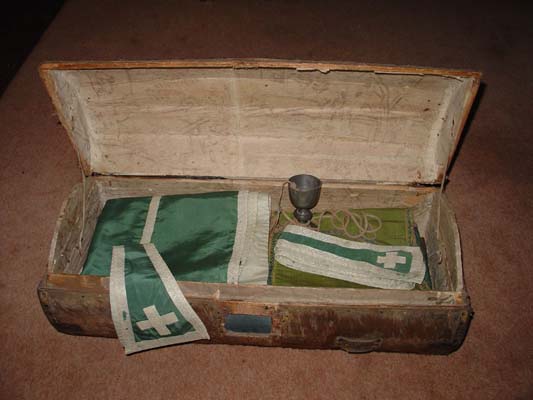
Disguised altar used at Pembridge Castle

Though warned of his coming seizure, he said, "As he had but a few years to live he would gain by suffering for the faith, and therefore would not abscond. He was committed to Hereford gaol, ordered up to London, and thence back to Hereford. In this last journey he suffered terribly from a painful malady, which necessitated him riding sideways. In prison he was frequently visited by Captain Scudamore's children, and he gave them many good things, their father being, he said, his best friend. On the scaffold he said, " It will be expected I should say something; but as I am an old man it cannot be much. Not having any concern in the plot, neither believing there is any, I die only for the old Roman Catholic religion, which first made England Christian, and whosoever would be saved must die therein. I beg pardon of all I have offended, and forgive those that have caused my death." From the local tradition that he smoked on his long walk to the gallows, the last pipe of the evening has been called the "Kemble pipe."

" Old age is a crown of dignity when it is found in the ways of justice."—PROV. xvi. 31.

Friday, August 22, 2014

+ Blessed WILLIAM LACY, Priest, 1582

THE HOLY HOUSE OF LORETO


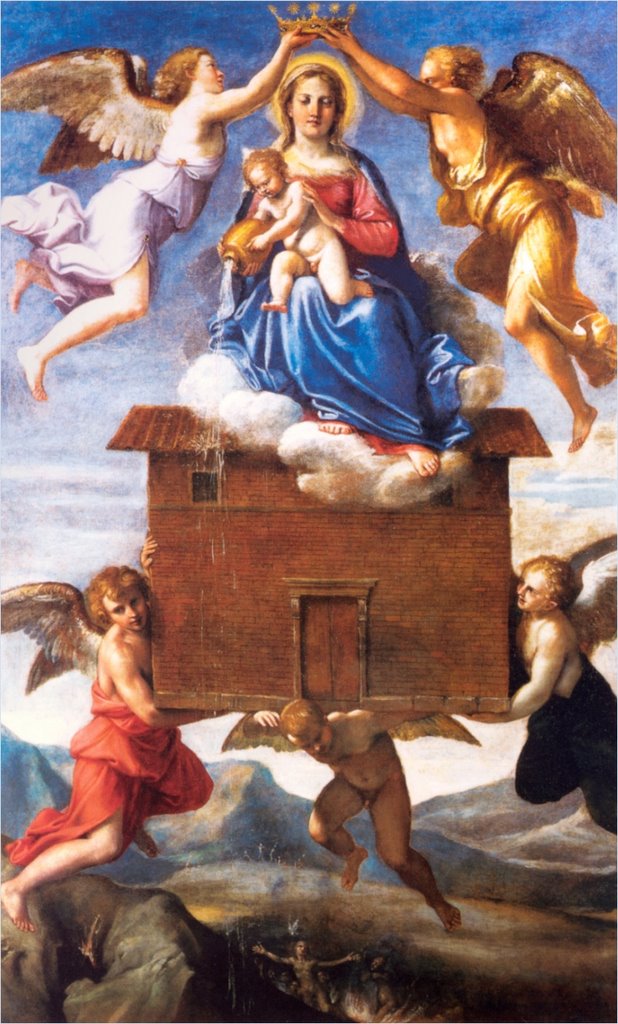
DRIVEN from York, where he held a high judicial post, hunted from place to place, penniless through fines for recusancy, as an aged widower he was ordained priest at Rome. At Loreto, on his way to England, he wrote, " I wish to take my leave of you once more with this letter, as I do not know whether it may be the last. We arrived on Tuesday at this holy house, where my companions and I served the Lord in his own home, and at the shrine of His most holy Mother.
At this we all experienced an extraordinary consolation, though indeed we felt much spiritual joy throughout the journey. I am particularly charmed with the devotion and zeal of my companions, and with the holy communings in which we pass our days. Indeed, it seems to me that I take my part with them in that sweet harmony. I frequently exclaim in my heart, ' Is Saul also amongst the prophets?' and I remind myself of the disciples' words : ' Was not our hearts burning when He spoke with us upon the way ?'" On being sentenced, the aged confessor said, " It is only paying the common debt a little sooner ; we will go into the house of the Lord." He suffered at York, August 22, 1582.


This is no other but the house of God and the gate of Heaven.—GEN. xxviii. 17.

Thursday, August 21, 2014

Blessed THOMAS PERCY, Layman., 1572


TORN from his friends and followers, from his wife and his four little girls, and betrayed into the hands of a declared enemy, B. Thomas in his captivity at Lochleven had indeed " sunk into deep waters among them that hated him " (Ps. Ixviii.). But he found strength from above in his continual fasts and watchings and pious meditations, and proved himself a true champion of the faith. His Calvinist keeper, the Lord of Lochleven, brought many of his sect to try and persuade him, by cunning argument and speeches or by threats and promises, to embrace their errors, but he could never be persuaded to depart in the smallest matter from the Communion of the Catholic Church. When, as often happened, meat was brought to him on days which Catholics observe as a fast, he contented himself with bread alone ; and by his example moved some of those attending on him to repent of their apostasy. The fortitude he thus acquired found a witness in Lord Hunsdon, who reported "that he is readier to talk of hawks and hounds than anything else, though very sorrowful and fearing for his life."

"Eleazer, one of the chief of the scribes, was pressed to eat swine's flesh. But he, choosing rather a most glorious death than a hateful life, went forward voluntarily to the torment."—2 MACH. vi. 18, 19

Wednesday, August 20, 2014

Blessed THOMAS PERCY, Layman, 1572


20 THIRTY PIECES OF SILVER

Biography

A GALLANT sight must have been the men of the Rising on the march. Nobles, knights with their tenants equipped for war, labourers and peasants unarmed but stout of heart, all wearing the Red Cross, their Standard the Five Sacred Wounds ;

its bearer, the grey-haired Richard Norton, late High Sheriff of Yorkshire. Among their chaplains, B. Thomas Plumtree, and heading the force the Earl and his brave-hearted Countess. They advanced as far south as Clifford Moor, near Wetherby, but their divided counsels and want of supplies forced them to retire, and at the advice of the Earl, anxious to avoid useless bloodshed, they dispersed. The cold-blooded revenge of Elizabeth displayed at once her avarice and cruelty. The gentlemen and yeomen were allowed to escape with a fine, but the peasants were hung by hundreds. The Earl fled to Scotland, and, consenting to meet an envoy from the Regent, was treacherously captured and confined in Lochleven. Thence after two years and a half imprisonment he was handed over to Elizabeth, who thirsted for his blood, for 2000 pounds. He was conveyed to York, where, after refusing to save his life by apostasy, he won his crown, August 22, 1572.


"But they appointed him thirty pieces of silver, and from thenceforth he sought opportunity to betray Him."—MATT. xxvi. 16.

Popular Posts