Visit the Bookshop


Showing posts with label 1591. Show all posts

Tuesday, December 16, 2014

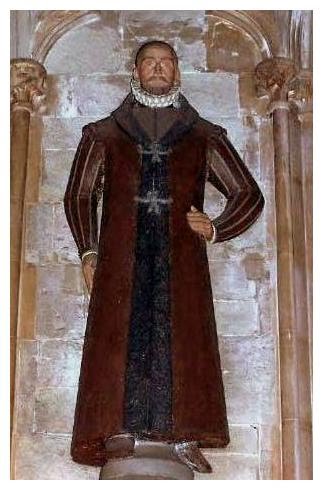
Saint SWITHIN WELLS, layman, 1591

IN BONDS, BUT FREE

“ I have been long in durance and endured much, but the future reward makes pain seem pleasure. And truly now the solitariness causes me not grief, but rather joy, for thereby I can better prepare myself for that happy end for which I was created and placed here by God. I am also sure that however few I see yet I am not deserted, for ‘ whose companion is Christ is never alone.’ When I pray I talk with God ; when I read He talketh to me. Thus, though I am bound and chained with gyves, yet am I loose and unbound towards God, and it is better, I deem, to have the body bound than the soul in bondage. I am threatened, Lord, with danger of death ; but if it be no worse I will not wish it better. God send me the grace, and then I weigh not what flesh and blood can do to me. These answered many anxious and dangerous questions, but I trust with good advisement, not offending my conscience. What will become of it God knows best, to whose protection I commit you. From gaol and chains to the Kingdom. Thine to life’s end.”—(Letter from prison.)

“ So then, brethren, we are not children of the bondwoman, but of the free, by the freedom whereby Christ has made us free.”—Gal. iv.31.

St Swithun, Bishop of Winchester, who was the name saint of Saint Swithin Wells


Saint SWITHIN WELLS, layman, 1591

A MIGHTY HUNTER

His father was renowned in Hampshire as a confessor for the faith, and Swithin himself— kindly, pleasant, courteous, generous, brave, a leader in every kind of field and manly sport— was an example of a Catholic country gentleman. Much of his diversions he gave up, however, to train youths in the faith and learning, who thus became staunch Catholics. Apprehended and condemned for having had Mass said in his house, he was led out to die with his wife, sentenced for the same offence. She was however remanded, and after ten years in Newgate of fasting, watching, and prayer, she died in 1602. On Swithin’s way to the scaffold, which was erected opposite his own door, meeting an old friend he said : “ Farewell all hawking and hunting and old pastimes ; I am now going a better way.” The butchery of Father Genings be­fore his eyes only hastened his own desire to die. “ Despatch,” said he ; “ Mr. Topcliffe, despatch; are you not ashamed to let an old man ^Stand here so long in his shirt in the cold. I pray God make you of a Saul a Paul, of a persecutor a Catholic professor.” And in such-like Speeches, full of Christian charity, piety, and courage, he happily ended his course, December 10, 1591.

 “He began to be mighty on the earth, and he was a stout hunter before the Lord.”—Gen. x, 8,9

Monday, December 15, 2014

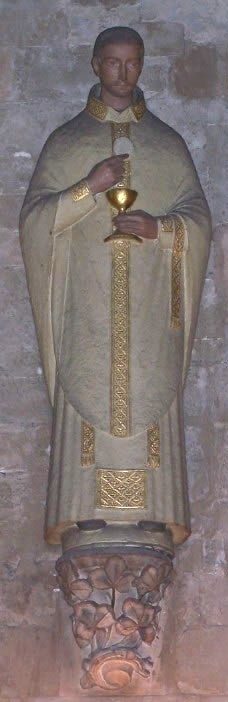
Saint EDMUND GENINGS, priest, 1591


“ Then the Protestant Bishop of London began, 


"You are greatly abused by those whom you call your Superiors. Think now of my counsel, which is to help yourselves, and to acknowledge your fault and error ; then doubtless I dare promise you from the Queen’s Majesty sure pardon. You miserable men do what in you is, to kill yourselves, which is a damnable thing, unless you now repent.’ On this Mr. Genings began to smile, and said that, though young, he thought he could answer the Bishop’s allegation. ‘ Peace,’ said the Bishop, ‘ I see you are all willful. Here I acquit myself before all this audience, that I have given you sound counsel. At the latter day, when you and I shall all stand before the Judge, this my word now shall condemn you,’ and with that the old dissembler wept, as it seemed, and wiped his eyes, trickling down with tears, every one as big as a millstone. ‘ Almighty God pardon your obstinacy. I may not stay to hear the just sentence of blood pronounced against you, because it is not according to my profession; ’ which said, he presently departed from the Bench. Many silly people commended his great charity and tender heart, as I heard them speak.”

“ And they went not into the hall, that they might not be defiled, but that they might eat the Pasch.”—John xviii. 28.

Sunday, December 14, 2014

Saint EDMUND GENINGS, Priest., 1591


On December 4, 1591, Father Genings and his companions were brought upon their trial, and a jury was empanelled to find them all guilty, yet nothing could any prove against them but that one of them had said Mass in Mr. Well’shouse, and that one of them had heard the said Mass. Many bitter words and scoffs were used by the judges and others on the bench, particularly to Father Genings, because he was very young and had angered them with disputes. And the more to make him a scoff to the people, they vested him not now in his priestly garments (in which they had before carried him throughthe streets), but in a ridiculous fool’s coat which they had found in Mr. Well’s house. On his return to Newgate, Topcliffe, Justice Young, and others called on him and offered him life, liberty, a benefice, and promotion if he would go to church and renounce his religion. But finding him constant and resolute they were highly offended, and thrust him into a dark hole, where he could not even see his hands nor get up or down without rjsk to his neck. Here he remained in prayer and contemplation without any food tili the hour of his death.

“And Herod with his army set Him at nought and mocked Him, putting on Him  a white garment, and sent Him back to Pilate.”—Luke xxiii.11.

Saturday, December 13, 2014

Saint EDMUND GENINGS, priest, 1591

INVOCATION OF THE SAINTS

He was executed with St Swithin Wells opposite the latter’s house in Gray’s Inn, where he had said Mass.
On the scaffold, in answer to Topclifife’s gibes, he professed his loyalty to his dear anointed Queen, and declared that being a priest and saying Mass in noways made him a traitor. Of these things he acknowledged him­self guilty, and rejoiced in having done such good deeds, and with God’s help would do them again at the risk of a thousand lives. Topcliffe, angered at this speech, bade them turn the ladder and cut the rope, so that the holy priest stood scarcely stunned on his feet, till the hang­man tripped him up, and quartered him while living. After he was dismembered he cried out in agony, “ It smarts ! ” To which Mr. Wells replied, “ Alas, sweet soul, thy pain is great, but almost past; pray for me now, most holy Saint, that mine may come.” After Father Genings was ripped up and his bowels cast into the fjre, the blessed martyr, his heart being in the executioner’s hands, uttered these words, “ Sancte Gregori, ora pro me,” at which the hangman swore a most wicked oath : “Zounds, his heart is in my hand, and yet Gregory is in his mouth. O egregious Papist.”

“ And the smoke of the incense of the prayers of the Saints ascended up before God by the hand of an angel.”—Apoc. viii. 4.

Wednesday, December 10, 2014

+ St Eustace WHITE, priest, 1591

THE SWEAT OF THE PASSION

He was born at Louth, Lincolnshire, and his conversion so much offended his father, an earnest Protestant, that he laid his curse upon him ; but God turned the curse to a blessing, and Eustace White became a priest and entered on the English Mission, October 1588. He was apprehended at Blandford, and having confessed himself a priest, a certain minister, one Dr. Houel, a tall man, reputed of great learning, was sent for to dispute with him, but was ignominiously vanquished, as he failed to disprove a certain text which White affirmed to be in the Bible
. At the Bridewell, London, he was once hung by Topcliffe in iron manacles for eight hours together ; but though the torment caused the sweat from his body to wet the ground beneath, nothing could be extracted from him of the least prejudice to Catholics. Under the extremity of his passion he cried out, “ Lord, more pain if Thou pleasest, and more patience.” To his torturer he said, “ I am not angry at you for all this, but shall pray to God for your welfare and salvatiön.” Topcliffe replied in a passion that he wapted not the prayers of heretics, and would have him hung at the next session. Then said the martyr, “ I will pray for you at the gallows, for you have great need of prayers.” He suffered at Tyburn, December 10, 1591.

“And His sweat became as drops of blood running down to the ground.”—Luke xxii. 44. 

Tuesday, December 09, 2014

Blessed JOHN MASON, layman, 1591


MALCHUS’ EAR

He had been servant to Mr. Owen of Oxford- hire, who was condemned at the bar as an aider and abettor of priests, and was himself first indicted for knowing and not revealing a seminary priest, but pleaded successfully that the three days allowed for such denunciations had not expired. He was then charged for abetting a priest to escape. On Topcliffe trying to enter the room where Father Gennings
was saying Mass, Mason seized him and thrust him downstairs, falling with him, and Topcliffe met with a broken head. This much the young man confessed. On this charge Mason was condemned, and executed the morrow after. Asked if he were not sorry for the fact, he re- plied, “No; if it were to do again, I would resist the wicked, that they should not have God’s priests, yea, although I were to be punished with twenty deaths.” There suffered with him a fellow-servant, Robert Sydney Hodgson, who, finding himself unpinioned, on the belief that he had recanted, boldly declared that, although he had asked Her Majesty’s pardon, he would not have the judge think that he would deny his faith, for that he would rather die twenty times first. They were suffered to hang tili they were dead, and together they won their crowns.— Tyburn, December 10, 1591.

“ And one of them that stood by, drawing a sword, struck a servant of the High Priest, and cut off his ear.”—MARK xiv. 47.

Popular Posts