Visit the Bookshop


Showing posts with label Venerable. Show all posts

Sunday, November 30, 2014

Venerable ALEXANDER CROWE, priest, 1587

SATAN THWARTED

A BOOTMAKER in York, he became a servant at the Seminary at Rheims, and for his virtues and diligence was admitted as a Student, and finally ordained priest. He arrived on the English Mission in 1584, and after nearly two years’ labour was arrested at South Duffield, where he had gone to baptize a child, and sentenced at York. On the night before his execution he was seen by a Catholic fellow-prisoner who shared his cell to be wrestling as it were in agony with some unseen foe, whilst he prayed continuously. At length he broke out with joy into the “ Laudate Dominum,”

and sank exhausted on his plank bed. He said he had been assaiied by the Evil One in a monstrous form, who assured him that his soul was lost, and urged him to take his life at once and not wait for the gallows. He was in the greatest strait when Our Lady and St. John the Evangelist appeared and put Satan to flight. Yet on the gallows the Evil One made a last final assault, and flung him off the« ladder. Though the fall was from a great height, the martyr rose unhurt, and, smiling, re- mounted the ladder and won his crown, 1587.

“Thou shalt walk upon the asp and the basilisk, and tread under foot the lion and the dragon.”—Ps. xc. 13.

Thursday, November 27, 2014

Venerable GEORGE ERRINGTON, layman and Companions, 1596

WOLVES IN SHEEP'S CLOTHING

GEORGE ERRINGTON, Gentleman, William Knight and William Gibson, Yeomen, were in prison at York Castle for recusancy.


Confined there also, for some misdemeanour, was a Protestant minister, who, to reinstate himself in the favour of his superiors, took the following treacherous course. He professed to the Catholic prisoners his sincere repentance for his previous life, and his desire of embracing the Catholic faith. They believed him sincere, and directed him when he was set free to Mr. Abbott, a zealous convert, who endeavoured to procure a priest to reconcile him, and took him to Squire Stapelton's house for this purpose, but in vain. The minister, having now evidence enough to bring them within the law, accused them to the magistrate, and thus displayed his zeal for the Protestant religion. They were all arraigned for high treason in persuading the minister to be reconciled to the Church of Rome. At the bar they confessed "that they had, according to their capacity, explained to the traitor the Catholic faith, but had used no other persuasion." Upon this they were found guilty, and suffered with joy, November 29.

"Beware of false prophets who come to you in sheep's clothing,, but inwardly ' they are ravening wolves."—MATT. vii. 15. 344

Friday, October 03, 2014

Venerable PHILIP POWELL, OSB, 1646

ADVOCATE OF CHRIST

Biography

OF a good Welsh family, he was trained for the law in London under Father Augustine Baker, then a famous lawyer in the Temple, who became a Benedictine monk. Powel followed his example and entered the same order, and in 1622 was sent on the English Mission. He laboured for some twenty years in Devon, till this county was so overrun with Parliament soldiers that the only safe place for Catholics was with Goring's army, and Powel accompanied it till the force was disbanded. He was arrested when on a vessel bound for Wales. 


In his defence at King's Bench he pleaded that Henry VIII made a statute of qualification of all statutes, and that the reason of Queen Elizabeth's statute against priests was her fears and jealousies of the Queen of Scots and the Spaniards, with both of whom priests were believed to have relations. This was, however, a time of civil war, when the King's person was absent, and could not, therefore, be the object of a plot. Hence, both the person and the cause being taken away, this latter statute might receive the benefit of mitigation. He added that he was not guilty according to the letter of Elizabeth's statute, being taken not in England but at sea. He was, however, hanged, Tyburn, June 30.

"And all that heard Him were astonished at his wisdom and answers."—LUKE ii. 47.

Saturday, August 09, 2014

+ Venerable THOMAS PALASOR, Priest, 1600

POISON DETECTED

Biography

A YORKSHIRE man by birth, he was apprehended as a priest in the house of Mr. John Norton in that county, with his host and Mr. John Talbot, and all three were confined in Durham gaol. There at dinner some broth was set before Mr. Palasor, and, on his preparing to taste it, the bone of mutton in the dish ran blood in the form of crosses, and of O's in the broth. He therefore abstained from taking it. The maid, noticing this, carried the broth back to her mistress, who spiced it over and sent it by the same maid to Mr. Talbot and Mr. Norton, when the same phenomenon was repeated. The maid, by name Mary Day, seeing this, came to Palasor, confessed that the broth had been poisoned by the malice of her mistress, the gaoler's wife, and on her knees begged his forgiveness, and asked him to make her one of his faith. She was instructed and reconciled, and became servant to a Catholic gentlewoman, Eleanor Forcer, who bore testimony to the above occurrence. Palasor was condemned to death for returning to England as a priest, contrary to the statute, and Mr. Norton and Mr. Talbot received the same sentence for harbouring and assisting him, and all three together were executed at Durham.

"They shall take up serpents, and, if they shall drink any deadly thing, it shall not hurt them."—MARK xvi. 18.

Sunday, August 03, 2014

+ Venerable THOMAS BELCHIAN, Franciscan, 1538

THE BAPTIST AND HEROD

Biography

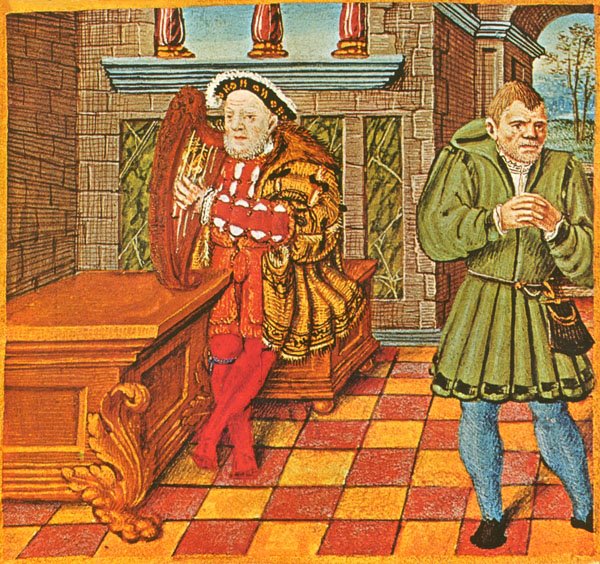
VERY learned and a great preacher, at the age of twenty-eight he distinguished himself by his bold opposition to the tyranny of Henry VIII. In his book on the text, "They that wear soft clothing are in King's houses" he denounced the vices of the court and the avarice of the pliant clergy, and was therefore cast into prison. There, while being slowly starved to death, he was subjected to every sort of torture, but triumphed over all. Mere skin and bone, when at the point of expiring he commended his soul to God in the words, "In Thee, O Lord, have I put my trust; let me never be confounded." As he expired the gaol shook as if with an earthquake, and the keepers were terrified. The King himself was startled by this supernatural warning, and ordered him a decent burial, and on reading Father Belchiam's book he burst out weeping and deploring bitterly his own misery. The good impression, however, soon faded out, and he commanded the book to be burnt. But the King's jester, William Summer, daft from his birth, ran through the King's court exclaiming, "The plain dealing of one beggar baffles the King's anger."


Here King Henry VIII pretends to be King David (in his own prayer book!) in the company of his jester.

"And the king was struck sad ; yet because of his oath and for them that sat with him at table ... he sent and beheaded John in prison."—MATT. xiv. 9, 10.

NOTE- I can find no other reference to this martyr- any information gratefully received.

Tuesday, July 29, 2014

Blessed WILLIAM WARD, Franciscan, 1641

A BURNING HEART

"BEHOLD the heart of a traitor!" cried the hangman, with the martyr's heart still palpitating in his hand, and threw it into the fire. Eager to obtain a relic, Count Egmont, a pious Catholic then in England, sent his servant with his handkerchief to dip it in the martyr's blood. Others, however, had been before him and not a drop remained. Searching in the ashes the servant found a heap of flesh singed with the fiery coals, and hastily wrapped the whole mass in his handkerchief. An attempt being now made to seize him, he fled across Hyde Park ; but as his pursuers gained he pretended to stumble, and hid his treasure in a bush as he fell. Taken before the magistrates, he was released through the Count's interest. The next day he returned and found his treasure, which proved to be the martyr's heart. As with St. Laurence, the divine fire within was stronger than the outward earthly flame. The hot coals adhering to the flesh had not burned the handkerchief, and the heart itself remained fifteen days incorrupt, when the Count had it embalmed, and took it to Paris with the relics of fourteen other martyrs whose executions he had witnessed, and on July 26, 1650, he signed and sealed the formal deed of authentication now in the archives of Lille.

"And there came in my heart as a burning fire shut up in my bones."—JER. xx. 9.

Saturday, May 03, 2014

John Henry Newman in 1854

comes to pray at the tomb of Blessed Dominic Barberi where he was then buried at Aston Hall. Dominic himself predicted that there would be priests forever in residence at Aston. He cannot have expected the present use.

ASTON HALL
by V. REV. CANON ARTHUR G. WALL

Aston Hall is situated in Aston, a village two miles south of Stone and about six miles north of Stafford.
The Hall contains bed-sitting rooms for eight priests who dine in community or in their own rooms if indisposed. There is an automatic lift to the bed-sitting rooms.
The Hall was purchased from Major Wenger in 1961 by Cyril Hartley, K.S.G., who gave it to the Birmingham Archdiocese as a guest house for retired and convalescent priests. Also, priests are welcome who wish to spend a little time and quietness in pleasant country surroundings. The Hall has a large garden, spacious grounds, and a field, altogether about six acres.
The Hall is served by a community of Sisters of Charity of St. Paul, whose head convent is at Selly Park, Birmingham. The Sisters are trained to serve the old and sick.

There is a very charming chapel in the Hall, near the main entrance, which is part of the Passionist Church erected by Blessed Dominic Barberi C.P.

The Hall is partly surrounded by a wide and deep moat (now dry). This gives some indication of the life of Aston Hall.

One of the glories of Aston is that with a few exceptions in recent times, it was always the home of good Catholic families. Old families like the Stanleys, Heveneninghams, Simeons and Welds were possessors. Early in the 19th Century there was a community of Franciscans, followed by Brigittine Nuns.

Father Benjamin Hulme was in charge of the Aston parish and lived in the Hall 1838-1842. Shortly after his arrival he was cleaning the Chapel when under the altar he found the lost relics of St. Chad. These relics are now the glory of St. Chads Cathedral, Birmingham.
In 1842 Father Dominic Barberi C.P. came to the Hall, and lived there until his death in 1849. The Passionist Fathers stayed on for some years and finally went to Sutton, near Preston, taking with them the body of Blessed Dominic.

After the departure of the Passionists the Aston parish was served by seculars. Father Huddleston (later Canon) was appointed Parish priest. He pulled down the old Hall and built the present one, finishing it in 1855. Canon Huddleston died in 1871. In 1909 the Hall was sold to non-Catholics and remained in non-Catholic hands until Major Wenger bought it.
Now it is a delightful home for retired and convalescent priests.

Many people have in recent years visited the Hall. Pilgrims come to see the hallowed spot where Blessed Dominic lived. Parish parties, desiring to see again their old Parish priest, come and are always welcome.

Priests and sick living in the Hall appreciate the good care and kindnesses of the Sisters in charge and find a great joy in living in a place hallowed by our grand old Catholic forefathers who kept the faith for us.

Tuesday, January 07, 2014

+ Venerable EDWARD WATERSON, Priest, 1593

BALAAM'S ASS

Biography

HE was born in London and brought up in the Protestant religion. In company with certain merchants he traveled to Turkey to see the East, and there a rich Turk, taking a fancy to him, offered him his daughter in marriage if he would renounce Christianity. Waterson, however, refused the proposal with horror, and taking Rome on his way homewards was instructed and reconciled to the Church. He was then admitted as a student at Rheims, and though he had but little learning, his zeal mastered all difficulties, and he was ordained priest in Mid-Lent 1592 and sent to England. Shortly after his arrival he was apprehended and condemned on account of his priesthood. Catholic eye-witnesses relate that, as he was being drawn to his execution, the hurdle suddenly stood still, and the officers in vain flogged the horses to move it. Fresh animals were secured, but they broke the traces, and the hurdle remained fixed. Waterson had therefore to be led on foot to the gallows; there the ladder shook violently of itself till the martyr by the sign of the Cross made it still, and ascending won his crown.

" And when the ass saw the angel standing she fell under the feet of the rider, who, being angry, beat her sides more vehemently with a staff."—NUM. xxii. 27.

Popular Posts