Visit the Bookshop


Showing posts with label Layman. Show all posts

Thursday, August 13, 2015

Blessed THOMAS PERCY, Layman, 1572

CLEANSING THE TEMPLE

Biography

THE first act of B. Thomas with his companions and followers on entering Durham was to seize the Cathedral and purge it of every heretical token. The Communion table was broken up, the Protestant Bible and Book of Common Prayer were burnt. The Catholic revival spread far and wide with marvelous speed.
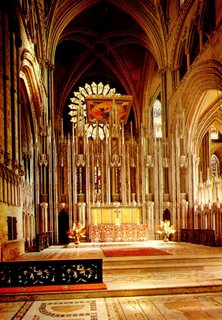


Altars were erected, holy water-stoups replaced, and everything prepared for the Holy Sacrifice. On Sunday, St. Andrew's Day 1569, the first High Mass was sung, the whole official choir assisting in the thronged Cathedral, and the reconciliation of Durham to the Church was crowned on December 4, then the second Sunday in Advent, by the priest F. Holmes bearing special faculties from Rome. Mounting the pulpit after preaching on the state of heresy and schism in the religion established by law, he exhorted his hearers to submit once more to the Holy See and to kneel down in proof thereof. He then publicly absolved the prostrate crowd, from their censure, and reconciled them to the Catholic Church. Holy Mass was then offered in reparation and thanksgiving.

"In the same day wherein the heathen had defiled it was it dedicated anew with canticles and harps and lutes and cymbals. And all the people fell upon their faces and adored and blessed up to Heaven Him that had prospered them." 1 MACH. iv. 54, 55.

We even know the identity of the organist at these Masses, one John Brimley.

His gravestone in the Galilee Chapel says:

John Brimleis body here doth li
Who praysed God with hand and voice
By musickes heavenlie harmonie
Dull myndes he maid in God rejoice
His soul into the heavens is lyft
To prayse him stil that gave the Gyft
Obiit Ao.Dni.1576 Octo.13.

Tuesday, December 16, 2014

Saint SWITHIN WELLS, layman, 1591

IN BONDS, BUT FREE

“ I have been long in durance and endured much, but the future reward makes pain seem pleasure. And truly now the solitariness causes me not grief, but rather joy, for thereby I can better prepare myself for that happy end for which I was created and placed here by God. I am also sure that however few I see yet I am not deserted, for ‘ whose companion is Christ is never alone.’ When I pray I talk with God ; when I read He talketh to me. Thus, though I am bound and chained with gyves, yet am I loose and unbound towards God, and it is better, I deem, to have the body bound than the soul in bondage. I am threatened, Lord, with danger of death ; but if it be no worse I will not wish it better. God send me the grace, and then I weigh not what flesh and blood can do to me. These answered many anxious and dangerous questions, but I trust with good advisement, not offending my conscience. What will become of it God knows best, to whose protection I commit you. From gaol and chains to the Kingdom. Thine to life’s end.”—(Letter from prison.)

“ So then, brethren, we are not children of the bondwoman, but of the free, by the freedom whereby Christ has made us free.”—Gal. iv.31.

St Swithun, Bishop of Winchester, who was the name saint of Saint Swithin Wells


Saint SWITHIN WELLS, layman, 1591

A MIGHTY HUNTER

His father was renowned in Hampshire as a confessor for the faith, and Swithin himself— kindly, pleasant, courteous, generous, brave, a leader in every kind of field and manly sport— was an example of a Catholic country gentleman. Much of his diversions he gave up, however, to train youths in the faith and learning, who thus became staunch Catholics. Apprehended and condemned for having had Mass said in his house, he was led out to die with his wife, sentenced for the same offence. She was however remanded, and after ten years in Newgate of fasting, watching, and prayer, she died in 1602. On Swithin’s way to the scaffold, which was erected opposite his own door, meeting an old friend he said : “ Farewell all hawking and hunting and old pastimes ; I am now going a better way.” The butchery of Father Genings be­fore his eyes only hastened his own desire to die. “ Despatch,” said he ; “ Mr. Topcliffe, despatch; are you not ashamed to let an old man ^Stand here so long in his shirt in the cold. I pray God make you of a Saul a Paul, of a persecutor a Catholic professor.” And in such-like Speeches, full of Christian charity, piety, and courage, he happily ended his course, December 10, 1591.

 “He began to be mighty on the earth, and he was a stout hunter before the Lord.”—Gen. x, 8,9

Tuesday, December 09, 2014

Blessed JOHN MASON, layman, 1591


MALCHUS’ EAR

He had been servant to Mr. Owen of Oxford- hire, who was condemned at the bar as an aider and abettor of priests, and was himself first indicted for knowing and not revealing a seminary priest, but pleaded successfully that the three days allowed for such denunciations had not expired. He was then charged for abetting a priest to escape. On Topcliffe trying to enter the room where Father Gennings
was saying Mass, Mason seized him and thrust him downstairs, falling with him, and Topcliffe met with a broken head. This much the young man confessed. On this charge Mason was condemned, and executed the morrow after. Asked if he were not sorry for the fact, he re- plied, “No; if it were to do again, I would resist the wicked, that they should not have God’s priests, yea, although I were to be punished with twenty deaths.” There suffered with him a fellow-servant, Robert Sydney Hodgson, who, finding himself unpinioned, on the belief that he had recanted, boldly declared that, although he had asked Her Majesty’s pardon, he would not have the judge think that he would deny his faith, for that he would rather die twenty times first. They were suffered to hang tili they were dead, and together they won their crowns.— Tyburn, December 10, 1591.

“ And one of them that stood by, drawing a sword, struck a servant of the High Priest, and cut off his ear.”—MARK xiv. 47.

Wednesday, November 26, 2014

Blessed MARMADUKE BOWES, layman, 1585

THE HOUSE OF ZACCHEUS

A Yorkshire gentleman, believing in his heart the Catholic faith, from fear of losing goods and liberty he would at times conform and go to the Protestant Church. Thus he led for long a miserable life, inwardly a Catholic, yet outwardly professing those very heresies which his soul detested. Notwithstanding, however, his schismatical dissembling, one grace he had, he never would close his doors to a priest whatever the cost might be, doubtless believing that by such works of mercy he might himself find in the end mercy at God’s hands. And so it proved. A young Catholic who had been schoolmaster to his children apostatised under torture, and became a fanatical informer bent upon the destruction of Catholics. He then accused Mr. Bowes of harbouring priests contrary to the statute, and both Mr. Bowes and his wife were imprisoned at York, but were released under bond of reappearance. At the next Assizes, on the evidence of the schoolmaster alone, Mr. Bowes was condemned, and in the three days before his execution he was reconciled to the Church and suffered boldly, professing his faith, and desiring that his death might be accepted in some measure in satisfaction for his profession of schism.

Sunday, October 19, 2014

+ Venerable PHILIP HOWARD, Layman, 1595

FROM PRISON TO PARADISE

Biography


AFTER his condemnation he rose at 5 A.M., and spent four or five hours every morning and three or four in the afternoon in prayer, so that his knees grew very hard and black. He fasted thrice a week, and on the Vigils of the great Feasts he had neither meat nor drink. In his spare time, besides a little physical exercise, he used his remarkable intellectual gifts in translating spiritual works. To the poor he gave much of his scanty allowance, and he intended, if ever it were possible, to restore all Church lands in his possession, to make his two houses monasteries, and himself to enter religion. Through his rigid confinement his body wasted while his soul waxed strong, till one day, at dinner, he was seized with a dysentery, which consumed him to skin and bone. The Queen refused his petition for a priest or for his wife and children to visit him, though this latter she had promised, but she sent word that, if he would go to church once, all would be granted, his honour and estates restored, and the fulness of her favour. He refused her offer, and after eleven years' imprisonment gave back his soul to God. He inscribed on his cell, " The more of suffering for Christ in this life, the more of glory with Christ in the next."


" The sufferings of this life are not worthy to be compared with the glory to come."—ROM. viii. 18.

Thursday, October 02, 2014

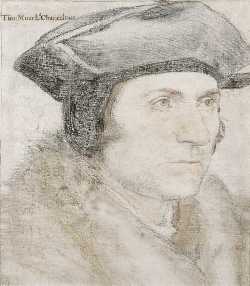
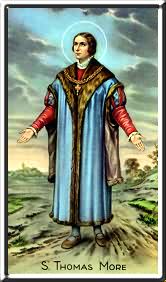
Saint THOMAS MORE, Layman, 1535

THE UNITY OF CHRISTENDOM

Biography


" SINCE I am condemned, and God knows how, I wish to speak freely of your statute for the discharge of my conscience. For the seven years that I have studied the matter, I have not read in any approved doctor of the Church that a temporal lord could or ought to be head of the spirituality. For one bishop of your opinion, I have a hundred saints of mine ; and for one Parliament of yours, and God knows of what kind, I have all the General Councils for 1000 years ; and for one kingdom, I have all the kingdoms of Christendom. I say further, that your statute is ill made, because you have sworn never to do anything against the Church, which through all Christendom is one and undivided, and you have no authority, without the common consent of all Christians, to make a law or Act of Parliament or Council against the union of Christendom. The true reason for my condemnation is my unwillingness to consent to the King's second marriage ; but I hope, in the Divine goodness and mercy, that as St. Paul and St. Stephen, whom he persecuted, are now friends in Paradise, so we, though differing here, shall be united hereafter. I pray God to protect the King and to give him good counsel."


" Every kingdom divided against itself shall be made desolate, and every city or house divided against itself shall not stand."—MATT. xii. 25 .

Friday, September 19, 2014

Blessed RICHARD HURST, Layman, 1628

PRAYERS FOR THE DEAD

THIS is his last letter to his confessor when about to suffer : " Now I take my last leave ; now I am dying, and am as willing to die as ever I was to live, I thank my Lord and Saviour, who I trust will never fail me. I have comfort in Christ Jesus and His Blessed Mother, my good angel, and all the blessed Saints, and in the valiant and triumphant martyr, B. Arrowsmith, who is gone before me. How I have been used you will hear, and likewise what I had offered me if I would have taken the oath. I hope my friends will truly understand that my greatest desire is to suffer, and I would I had as many lives to offer as I have committed sins. Now, dear Sir, prepare yourself also to suffer, and animate your ghostly children in suffering. Once again, I desire you to say and to procure some Masses for my sinful soul, and if it please God to receive me into His kingdom, I shall not be unmindful of you and of all my good friends. I pray you remember my poor children, and encourage my friends about my debts which my chief worldly care is to satisfy. Once again, adieu. I desire to be dissolved, and to be with Christ Jesus:"

" He sent twelve thousand drachms of silver for sacrifice to be offered for the sins of the dead, thinking well and religiously concerning the Resurrection."—2 MACH. xii. 43.

Thursday, September 18, 2014

Blessed RICHARD HURST, Layman, 1628

STRONGER THAN DEATH

HE wrote before his death three letters to his confessor. The first is as follows : " I received your letter with news of death, at which I am not much dismayed, I thank my Lord and Saviour; the more malicious my enemies the greater my comfort, for I do constantly believe that my religion is the cause of their malice, and my greatest desire is to offer my blood in so good a cause. And although my flesh be timorous and fearful, I yet find great comfort in spirit, in casting myself upon my sweet Saviour with a most fervent love, when I consider what He hath done and suffered for me; and I had rather die a thousand deaths than possess a kingdom and live in mortal sin ; for there is nothing so hateful to me as sin, and that only for the love of my Saviour. I do most constantly believe that He hath afflicted me to save me, and I trust I shall die truly humbled, for the which I desire your good prayers, that I may persevere to the end ; for of myself I can do nothing without His grace." He left behind him six little children, and his wife with child.

" Lord, Thou knowest all things, Thou knowest that I love Thee."—JOHN xxi. 17

Saturday, September 13, 2014

Blessed ADRIAN FORTESCUE, Layman

MARTYR'S MAXIMS (2)

BE not partial for favour, lucre, or malice, but according to truth, equity, justice, and reason.

Be pitiful to poor folk and help them to thy power, for then thou shalt greatly please God.

Give fair language to all persons, and especially to the poor and needy.

Also be diligent in giving of alms.

In prosperity be meek of heart, and in adversity patient.

And pray continually to God that you may do what is His pleasure.

Also apply diligently the co-operations of the Holy Ghost whatever thou hast therein to do.

Pray for perseverance.

Continue in dread, and ever have God before thine eyes.

Renew every day thy good purpose.

What thou hast to do, do it diligently.

'Stablish thyself always in well-doing.

If by chance you fall into sin, despair not, and if you keep these precepts, the Holy Ghost will strengthen thee in all other things necessary, and thus doing you shall be with Christ in Heaven, to whom be glory, laud, honour, and praise everlasting.

" She conducted the just through the right ways and showed him the kingdom of God, and gave him the knowledge of holy things."— WlS. x. 10.

Friday, September 12, 2014

Blessed ADRIAN FORTESCUE, Layman

A MARTYR'S MAXIMS (1)

Biography


ABOVE all things love God with all thy heart.


Desire His honour more than the health of thine own soul.

Take heed with all diligence to purge and cleanse thy mind with oft Confession, and raise thy desire or lust from earthly things.


Be you houseled (that is receive Holy Communion) with entire devotion.

Repute not thyself better than any other person, be they never so great sinners, but rather judge and esteem yourself most simplest.

Judge the best.

Use much silence, but when thou needs must speak.

Delight not in familiarity of persons unknown to thee.

Be solitary as much as is convenient with thine estate.

Banish from thee all judging and detraction, and especially from thy tongue.

Pray often.

Also enforce thee to set thy house at quietness.

Resort to God every hour.

Advance not thy words or deeds by any pride.

Be not too much familiar, but show a serious and prudent countenance with gentleness.

Show before all people a good example of virtues.

" The Wisdom from above is first chaste."— JAS. iii. 17.

Thursday, September 11, 2014

ROBERT DYMOKE, Layman., 1580

HEREDITARY CHAMPION OF ENGLAND

Biography


SCRIVELSBY COURT (demolished 1961), Lincolnshire,


the home of the Dymokes, was one of the centres of the Rising in that county. The " articles of grievance " devised by the insurgents were drawn up by the Dymokes. Robert had so far conformed as to attend the Protestant service, while he harboured a priest, B. Kirkman, in his house disguised as a schoolmaster to his sons. This act of hospitality, with the risks it involved, seems to have procured for him the grace of complete conversion. On July 24, 1580, Robert and his wife, Lady Bridget, were indicted for hearing Mass and for non-attendance at the Protestant service. Though helplessly paralysed, he was carried to Lincoln, and in a miserable prison there fell dangerously ill. Even when dying he was not left in peace. " They come," writes Father Persons, "when he is wrestling with the pangs of death. Even then the ministers do not permit him to die, as he desires, a Catholic death. They urge him to pray such sorry prayers of their own making as in health he contemned, in sickness with open voice he rejected, and now dumb and half dead, by his countenance, by signs and tokens, and by gesture of his body, he did utterly contemn and abhor."

" Who by faith conquered kingdoms, wrought justice, obtained promises, stopped the mouths of lions."—HEB. xi. 33.

Sunday, September 07, 2014

One Frances DRURY

was prosecuted in 1584 for hearing Catholic Mass said by Father Monford Scott on this day 1583.

Tuesday, September 02, 2014

Saint THOMAS MORE, Layman, 1535

TIME AND ETERNITY

Biography


WHEN his wife came to see him she reproached him roundly for preferring to stay among the rats and mice in a close, filthy prison, when he might be enjoying his liberty, the goodwill of the King, and the company of his family in his " right fair" house at Chelsea. " I muse what a God's name you mean here still thus fondly to tarry," she cried. Sir Thomas said cheerfully, "I pray thee, good Mistress Alice, tell me one thing : is not this house as near Heaven as mine own?" " Tilly vally, tilly vally," quoth she, in her homely fashion. " Bone Deus, man, will this gear never be left ? " " Well, then," quoth he, " I see not why I should much joy in my house, when, if I arose after being seven years dead, the new owner would bid me get out of doors, or why should I like a house so soon forgetful of his master? How long do you think we may live and enjoy it ? " " Some twenty years," said she. " Truly," replied he, "if you had said some thousand years it had been somewhat; and yet he were a bad merchant that would risk Eternity for a thousand years ; how much the rather, if we are not sure to enjoy it one day to an end."


"One day with the Lord is as a thousand years, and a thousand years as one day."— 2 PET. iii. 8.

Thursday, August 21, 2014

Blessed THOMAS PERCY, Layman., 1572


TORN from his friends and followers, from his wife and his four little girls, and betrayed into the hands of a declared enemy, B. Thomas in his captivity at Lochleven had indeed " sunk into deep waters among them that hated him " (Ps. Ixviii.). But he found strength from above in his continual fasts and watchings and pious meditations, and proved himself a true champion of the faith. His Calvinist keeper, the Lord of Lochleven, brought many of his sect to try and persuade him, by cunning argument and speeches or by threats and promises, to embrace their errors, but he could never be persuaded to depart in the smallest matter from the Communion of the Catholic Church. When, as often happened, meat was brought to him on days which Catholics observe as a fast, he contented himself with bread alone ; and by his example moved some of those attending on him to repent of their apostasy. The fortitude he thus acquired found a witness in Lord Hunsdon, who reported "that he is readier to talk of hawks and hounds than anything else, though very sorrowful and fearing for his life."

"Eleazer, one of the chief of the scribes, was pressed to eat swine's flesh. But he, choosing rather a most glorious death than a hateful life, went forward voluntarily to the torment."—2 MACH. vi. 18, 19

Wednesday, August 20, 2014

Blessed THOMAS PERCY, Layman, 1572


20 THIRTY PIECES OF SILVER

Biography

A GALLANT sight must have been the men of the Rising on the march. Nobles, knights with their tenants equipped for war, labourers and peasants unarmed but stout of heart, all wearing the Red Cross, their Standard the Five Sacred Wounds ;

its bearer, the grey-haired Richard Norton, late High Sheriff of Yorkshire. Among their chaplains, B. Thomas Plumtree, and heading the force the Earl and his brave-hearted Countess. They advanced as far south as Clifford Moor, near Wetherby, but their divided counsels and want of supplies forced them to retire, and at the advice of the Earl, anxious to avoid useless bloodshed, they dispersed. The cold-blooded revenge of Elizabeth displayed at once her avarice and cruelty. The gentlemen and yeomen were allowed to escape with a fine, but the peasants were hung by hundreds. The Earl fled to Scotland, and, consenting to meet an envoy from the Regent, was treacherously captured and confined in Lochleven. Thence after two years and a half imprisonment he was handed over to Elizabeth, who thirsted for his blood, for 2000 pounds. He was conveyed to York, where, after refusing to save his life by apostasy, he won his crown, August 22, 1572.


"But they appointed him thirty pieces of silver, and from thenceforth he sought opportunity to betray Him."—MATT. xxvi. 16.

Tuesday, August 12, 2014

Blessed THOMAS PERCY, Layman, 1572

THE ABOMINATION OF DESOLATION

Biography


THE freedom to practise their religion, which Catholics had regained under Mary, was rudely swept away by Elizabeth. By the Act of Supremacy the authority of the Pope was abolished, and his jurisdiction transferred to the Crown. By the Act of Uniformity the Holy Sacrifice of the Mass was prohibited, and in alj churches the Protestant Book of Common Prayer was alone to be used. Transgression of the above Acts incurred for the first offence forfeiture of property, for the second perpetual imprisonment, for the third death. Thus the sanctuaries revered for ages became empty sepulchres. The Royal Arms were substituted for the Crucifix, the images of Our Lady and the Saints were torn down, and the innumerable altars overturned and desecrated. Non-attendance at the Protestant Church was punishable with a fine ; the exercise of any priestly office with imprisonment—if repeated, with death. This sacrilegious usurpation of religious authority by the Crown, the privation of the Sacraments even at the hour of death, the absolute hopelessness of obtaining any constitutional redress, led to the Northern Rising, in which B. Thomas Percy, Earl of Northumberland, laid down his life for the faith.

"And behold our sanctuary and our beauty and our glory is laid waste, and the Gentiles have defiled them. To what end, then, should we live any longer?"—1 MACH. ii. 12.

Friday, August 08, 2014

Blessed JOHN FELTON, Layman, 1570

CHAMPION OF THE POPE

As a cruel persecutor of the faith she had sworn to defend, Elizabeth was excommunicated and deposed by St. Pius V, February 24, 1570, and the Bull of excommunication was found on May 25, the Feast of Corpus Christi, on the gates of the Bishop of London's palace, where it had been placed by John Felton, a brave and zealous Catholic gentleman. After this act he refused to fly, trusting, he said, to God's grace for whatever might happen, and when the escort arrived for his arrest, he voluntarily surrendered himself. Both at his apprehension and his trial, he openly acknowledged having posted up the Bull, and said that, as he held the Pope to be the Vicar of Christ, what came from him ought to be duly venerated. Notwithstanding this public confession, he was three times racked in the vain hope of extracting from him admission, compromising others. In his satin doublet, on the day of his martyrdom, as he faced the crowd, calm and unmoved, he looked indeed a royal champion, and he told the people that he died for the Catholic faith. His last words on being disembowelled were " Jesus, Jesus." He sent the Queen, from the scaffold, a ring worth ^400, showing he bore her personally no ill-will. He suffered, St. Paul's Churchyard, London, August 8.

"Thou art Peter, and upon this rock I will build My Church."—MATT. xvi. 18.


Other martyrs connected with the Excommunication
Martyrs connected with the Excommunication: Thomas Plumtree p., 4 Jan., 1571; John Storey, D.C.L., 1 June, 1571; Thomas Percy. Earl of Northumberland, 22 Aug., 1572; Thomas Woodhouse p., 13 June, 1573.

Friday, August 01, 2014

JOHN THOMAS, Layman, 1593

PETER REPENTANT

HE was condemned, together with Bird, but, horrified at the sentence of death, promised the judge he would go to Church. The judge could not recall the sentence given, so countermanded his execution till the Queen's pardon should arrive. On his return to prison, helped probably by Bird's exhortations, he conquered the fear of death by the fear of Hell, and sent word at once to the judge that he repented of his cowardice, and would do nothing contrary to his duty as a Catholic. The judge said, " Is he in such a hurry for the gallows ? Let him not be afraid ; if he persists we can hang him at the next assizes." Yet he appeared at the gallows with the other criminals, carrying his winding-sheet, and said to the Sheriff he had been condemned and had come to die. But the Sheriff said that, though he would meet his wishes with the greatest pleasure, were it in his power, he could not do so, as his name was not on the list. So Thomas retired, lamenting his sin and his past life, for he had been a Calvinist minister ; but God did not fail him, and, purged by a long penance, with a large increase of merits, in the August following he obtained what he desired, at Bardich, Winchester.

" And the Lord turning looked on Peter . . . and Peter going out wept bitterly."—LUKE xxii. 61, 62.

Thursday, July 17, 2014

Blessed ROBERT GRISSOLD, Layman, 1604

GRESWOLD alternative spelling

ZEAL FOR MARTYRDOM

Biography

HE was apprehended by his cousin, Clement Grissold, for being in company with a priest, Blessed Sugar, and refused to escape, both for his love of the martyr and his own zeal to suffer. At the Assizes at Warwick he was repeatedly offered his liberty if he would promise to go to church, but each time absolutely refused. On the morning of his execution he spent one hour in prayer, and begged all the Catholics to say a Pater and Ave in honour of God and St. Catherine, his patroness, Virgin, and Martyr, for fortitude in his passion. To a Catholic woman in tears, he said, " This is no place for weeping, for you must come into the Bridegroom's chamber, not with tears, but with rejoicing." As he walked to the gallows he was bid not to follow Blessed  Sugar, who was being drawn through the mud ; but he said, " I have not thus far followed him to leave him for a little mire." Although so timorous by nature that he would swoon at the sight of blood, he gazed unmoved at the quartering of Blessed Sugar's body, and, taking the halter with which he was to be hung, dipped it in Blessed  Sugar's blood, and gave God thanks that he was to die with him. He suffered at Warwick, July 16.

"For I am ready not only to be bound, but to die also in Jerusalem, for the name of the Lord Jesus."—ACTS xxi. 13.

Beatified by Pope John Paul II in 1987.

Popular Posts