Visit the Bookshop


Showing posts with label Jesuit. Show all posts

Friday, December 12, 2014

+ Blessed THOMAS HOLLAND, Jesuit, 1642

Born in Lancashire, he was educated at St. Omer’s, where he was repeatedly, on account of his piety, elected prefect of the Sodality of Our Blessed Lady. Thence he was sent to Valla­dolid, and was chosen to make a Latin oration at Madrid before Charles Prince of Wales (Charles I), on occasion of a marriage then pro- posed with the Infanta Maria. Returning to Flanders, he entered the Society of Jesus, and was sent on the English Mission to London, 1634. He was then in very bad health, and his illness was increased by the close confinement imposed upon him by the unremitting house- searching of the pursuivants. Yet, notwith- standing the vigilance of his enemies and his own infirmities, through the various disguises he adopted, so as to be unrecognisable even by his friends, his perfect knowledge of French, Fle­mish, and Spanish languages enabling him to assume any character, he reaped auring two year's labour a rich harvest of souls. At length in 1642 he was apprehended on suspicion and sentenced. In prison his holy counsel and deep spiritual wisdom sanctified the throngs, English and forejgü, who came for his last words. He said Mass and administered the Sacraments up to the day of his execution at Tyburn, Decem­ber 12, 1642.

“ I became all things to all men that I might save all.”—1 Cor. ix. 22.

Wednesday, December 03, 2014

Saint ALEXANDER BRIANT, Jesuit, 1581

THE CROSS AND THE CROWN

WHEN he went to Westminster Hall to be condemned he made a cross of such wood as he could get, apparently a small wooden trencher, and upon it he drew with charcoal a figure of our Lord. This rough crucifix he carried with him openly. He made shift also to shave his crown because he would signify to the prating ministers which scoffed and mocked him that he was not ashamed of his Holy Orders, nor yet that he would blush at his religion. When then the ministers reproached him and bade him cast his crucifix away, he answered : “ Never will I do so, for I am a soldier of the Cross, nor will I henceforth desert this Standard until death.” Another stretched forward and snatched the cross from his hands, upon which he said : “ You may tear it from my hands, but you cannot take it from mv heart. Nay, I shall die for Him who first died on it for me.” On the scaffold, with his fair and honest face beaming with joy, he expressed his great happiness in being made worthy to die for the faith, and in Company with Edmund Campion whom he heartily revered. As the words of the Miserere were on his lips the cart was drawn away.

“God forbid that I should glory save in the Cross of our Lord Jesus Christ, by whom the world is crucified to me and I to the world.”— GAL. vi. 14.

Saturday, November 22, 2014

St ROBERT SOUTHWELL SJ, 1595

WILLING SACRIFICES

He thus describes the condition of his fellow Catholics, priests and laity : “ As yet we are alive and well, being unworthy, it seems, of prisons. We have oftener sent than received letters from your parts, though they are not sent without difficulty, and some we know have been lost. The condition of Catholic recusants here is the same as usual, deplorable and full of fears and dangers, more especially since our adversaries have looked for wars. As many of ours as are in chains rejoice and are comforted in their prisons; and they that are at liberty set not their hearts upon it nor expect it to be of long continuance. All, by the great goodness and mercy of God, arm themselves to sufifer anything that can come, how hard soever it may be* as it shall please our Lord, for whose greater glory and the Salvation of their souls they are more concerned than for any temporal losses. A little while ago they apprehended two priests, who have suffered such cruel usages in the prison of Bridewell as can scarce be believed. What was given them to eat was so little in quantity, and withal most filthy and nauseous.”

“Then said I, Behold I come to do Thy will, O my God.”—Ps. xxxix. 7, 9.

Monday, October 06, 2014

GEORGE GILBERT, Jesuit, 1583

THE CATHOLIC ASSOCIATION

OF an old Suffolk family, possessed of a large fortune, a Puritan by profession, he followed in his youth the life of a gay cavalier. Going abroad, however, his eyes were opened to the faith, and he was reconciled by Father Parsons at Rome. Returning to England, he devoted himself to the services of the missionary priests, and formed for this purpose, with Lord Henry Howard, Lord Oxford, Mr. Southwell, Lord Paget, and other young men, a " Catholic Association," which was solemnly blessed by Pope Gregory XIII, on April 14, 1580. The members promised to imitate the lives of the Apostles, and to devote themselves wholly to the salvation of souls and the conversion of heretics. They were to be content with the necessaries of their state, and to bestow all the rest for the good of the Catholic cause. They supplied the priests with altar requisites, with horses, and various changes of apparel, and disguised themselves as grooms or servants and escorted the priests through the country from house to house. To Gilbert is due the first idea of the frescoes of the English martyrs in the English College, Rome. He was admitted to the Society of Jesus on his death-bed.


" And the multitude of believers had but one heart and one soul, neither did any one say that aught of the things he possessed was his own, but all things were common unto them."—ACTS iv. 32.

Saturday, October 04, 2014

Saint EDMUND CAMPION, Jesuit, 1581

THE FINAL JUDGMENT

Biography


"IT was not our death that ever we feared, but we knew that we were not lords of our own lives, and therefore, for want of answer, would not be guilty of our own deaths. The only thing that we have now to say is, that if our religion do make us traitors, we are worthy to be condemned, but otherwise are and have been as true subjects as ever the Queen had. In condemning us you condemn all your own ancestors—all the ancient priests, bishops, and kings—all what was once the glory of England, the island of Saints, and the most devoted child of the See of Peter. For what have we taught, however you may qualify it with the odious name of treason, that they did not uniformly teach ? To be condemned with these old lights —not of England only, but of the world—by their degenerate descendants is both gladness and glory to us. God lives : posterity will live : their judgment is not so liable to corruption as that of those who are now going to sentence us to death." "Never," says Fitzherbert, "was Campion's face more noble ; his conduct had been calm and dignified, and his arguments pointed and conclusive ; but in this last speech he surpassed himself'


"And after this the judgment."—HEB. ix. 37.

Monday, September 22, 2014

Sainthttp://drbo.org/x/d?b=drl&bk=54&ch=10&l=1#x, Jesuit, 1628

LOWLY BUT BOLD

HE is described as being, like St. Paul, of mean presence, but of great innocency of life, and so zealous, witty, and fervent that his eagerness to dispute with heretics, had he not been restrained, would have brought him too soon into danger of death. A Protestant gentleman, thinking from his appearance he might be easily befooled, tried to jest upon him, but his retorts were so sharp that the gentleman swore that where he thought he had met a mere simpleton he had found a foolish scholar or a learned fool. He had such great power in freeing possessed persons, during his fifteen years of priestly labour, first as a secular then as a Jesuit, that at his last trial the judge pleaded for his death as too dangerous a seducer to be set at liberty. Dr. Bridgman, Bishop of Chester, before whom he was once brought at supper-time in Lent, excused himself for eating flesh, as being dispensed on account of- weakness. " But who dispenses your lusty ministers there, who have no such need, and all eat flesh?" As divers ministers together attacked him, he said to the Bishop, "Turn all your dogs at once against me, and let us have a loose bait."

" Now I, Paul, beseech you by the mildness and modesty of Christ, who in presence indeed am lowly among you but being absent am bold towards you."—2 COR. x. i

Sunday, September 21, 2014

Saint EDMUND ARROWSMITH, Jesuit, 1628

A HOLY YOUTH

His family were great sufferers for the faith. His maternal grandfather, Mr. Nicholas Gerard, being unable to move with the gout, was carried to the Protestant Church and placed close to the minister, but he sang Psalms in Latin so loud that the minister was inaudible, and he had to be removed. His parents and their household were driven, tied two and two, to Lancaster gaol, the four youngest children, of which Edmund was one, being left homeless and unclad until some charitable neighbours took compassion on them. After some years, to ease his now widowed mother of her burden^ a venerable priest took charge of Edmund. As the boy went to school, about a mile distant, his daily practice was to recite with his companions the little hours of Our Lady's Office, and on his way back the Vespers and Compline. After his return home he would withdraw to his oratory and there perform his customary devotions of the Jesus Psalter, the Seven Psalms, &c, and so engaging were his tempef and manners that he won the affection of even the Protestant schoolmaster. His priestly studies, though often interrupted by his bad. health, were completed at Douay, whence he went on the English Mission, 1613.

"When he was yet a boy he began to seek the God of his father David."—2 PARAL. xxxiv.3

Tuesday, September 09, 2014

Venerable RALPH CORBY, SJ and Venerable JOHN DUCKETT, Priest, 1644

THE KISS OF PEACE

HAVING each refused to be spared at the cost of the other's life, they were sentenced to death, and returned with joy to prison, there to wait. V. Corby wrote: " For that holy and happy Saturday (September 7), which is the vigil of her glorious Nativity, by whose holy intercession I hope to be born again to a new and everlasting life." Their last day and the whole ensuing night was spent in prayer, fasting, watching, and in spiritual conferences with those who came to confess and to hear their last Mass. Amongst these were the Duchess of Guise and the French envoy. Father Corby in his last Mass appeared to be overwhelmed with an agony of sadness and fear. At length the cloud passed, and his joy returned. They went out to suffer with their tonsures shaved, the one in his Jesuit's habit, the other in his priest's cassock. At the gallows Father Duckett made no speech, but told an heretical minister that he had not come hither to be taught his religion, but to die for it. After a short discourse from Father Corby, the two confessors turned to each other. Together they had been arrested, supported each other by their mutual courage and self-sacrifice, and with a last most loving embrace they together received their eternal crown.

" Salute one another in a holy kiss; all the saints salute you."—2 COR. xiii. 12.

Monday, September 08, 2014

Venerable RALPH CORBY, Jesuit and Venerable JOHN DUCKETT, Priest, 1644

HOLY RIVALRY

Biographies of Ralph Corby and John Duckett

RALPH CORBY, alias Darlington, was born near Dublin of English parents, natives of Durham, whothat both parents and children entered into religion : the father and his three sons into the Society of Jesus, the mother and her daughters into the Order of St. Benedict. After twelve years' hard work, notwithstanding continuous ill-health, among the poorer Catholics in Durham, he was arrested and sent up to London with Father Duckett. They were escorted from Westminster to Newgate by a company of Parliament soldiers, with a captain at their head, beating drums and firing off their muskets through the crowded streets, as if they had been the enemy's generals taken in war as in the old Roman battles. In prison the life of one of them could have been saved by an exchange made for a prisoner in the hand of the Emperor of Germany. The offer was first made to Father Corby, who declined it on the ground that Father Duckett, being younger, could do more work than himself; but he in his turn refused it with thanks, as Father Corby's life, on account of his experience, was of greater value.
had gone over to Ireland for the free exercise of their religion. The piety of the family is sufficiently attested by the fact

" Behold what manner of charity the Father hath bestowed upon us."—1 JOHN iii. 1.

Thursday, August 28, 2014

+ Venerable Edmund Arrowsmith, SJ, 1628

STRIKING THEIR BREASTS
Biography
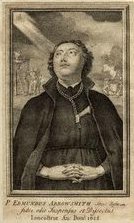
HE was sentenced at Lancaster for being a priest, a Jesuit, and a persuader of religion, and the judge ordered that he was to be hung at noon, when most men would be at dinner ; but as it fell out the whole place of execution was covered with great multitudes of people of all sorts, ages, sexes, and religions, expecting the end of the tragedy. As he was carried through the castle yard, Father Southworth, his fellow-prisoner under reprieve, appeared at the prison window and received his absolution. He was then bound on the hurdle, with his head towards the horse's tail, " for greater ignominy." Most of his friends were prevented to approach him, and the executioner went before the horse and hurdle with a club in his hand in a kind of barbarous triumph. On the scaffold he refused to save his life by taking the oath, professed that he died for the Catholic faith, and prayed for the conversion of England. His last words, as he was cast off the ladder, were "Bone jesu." Divers Protestants, beholders of this bloody spectacle, wished their souls with his. Others wished they had never come there. Others said it was a barbarous act to use men so for their religion.

"And all the multitude of them that were come together to that sight, and saw the things that were done, returned striking their breasts." —LUKE xxiii. 48.

See also Arrowsmith House.

Monday, August 25, 2014

Saint DAVID LEWIS also known as CHARLES BAKER, Jesuit, 1679

REPROACHED FOR CHRIST

Biography


Born of Protestant parents in Monmouthshire, he was reconciled at the age of nineteen, when a law student in London. Ordained at the English College, Rome, he entered the Society, and was sent on the English Mission in 1648. For thirty-one years he toiled for souls, fearless in dangers, patient in suffering, till his apprehension, November 19, 1678. While in the hands of his captors he was summoned to a dying priest, Father Ignatius Price, who was sinking from hunger and cold and the hardships of a hunted life, but he could only send him his best wishes for eternity, and after three days Father Price died. At Monmouth Father Baker, in spite of a brilliant defence, was condemned and sent up to London, where Lord Shaftesbury suggested to him to save his life and improve his fortune by revealing something of the plot or conforming in religion ; but he refused, for of the plot he knew nothing, and to conform would be against his conscience. On the scaffold he forgave his persecutors, and to the Catholics he said : " Fear God, honour the King. Be firm in your faith ; bear patiently persecutions, always remembering St. Peter's words, that reproach borne not for any evil thing, but for Christ's sake, is a blessing." He suffered at Usk, August 27, 1679."


If you be reproached for the name of Christ you shall be blessed : for that which is the honour of God resteth on you."—1 Pet. iv. 14.

Friday, July 04, 2014

+ Blessed John Cornelius, Jesuit, 1594

Also called Mohun

A MAN OF GOD

Biography

He said Mass every day at five o'clock in the morning, and never without tears. At the reading of the Passion in Holy Week again he wept exceedingly. He was sometimes in an ecstasy when praying, and was found once on his knees, his hands crossed on his breast, and his eyes raised to Heaven, so absorbed in God that it was doubtful whether he was alive or dead. He always wore a rough hair-shirt, used frequent disciplines, and for many years fasted four days a week. He gave to the poor all that came to his hands, committing the care of himself to God's providence. He preached twice a week, gave catechetical instructions for almost an hour, and read some pious lessons for about half-an-hour in the evening to those aspiring to perfection. The mortification of his senses and his recollection in God were so great that for three whole years that he lodged in a room, the windows of which looked upon the Parish Church, he had never observed it, nor did he know whether the house in which he lived was leaded or tiled. Upon several occasions his face was illuminated with a heavenly light. He suffered at Dorchester, July 4, 1594


" But thou, O man of God . . . pursue justice, godliness, faith, charity, patience, mild­ness."—1 Tim. vi. 11.

Sunday, June 29, 2014

Venerable ROBERT SOUTHWELL, Jesuit

ST. PETER'S REMORSE

Biography


IT is a small relief
To say I was thy child,
If, as an ill-deserving foe,
From grace I am exiled.

I was, I had, I could—
All words importing want;
They are but dust of dead supplies,
Where needful helps are scant.

Once to have been in bliss
That hardly can return,
Doth but bewray from whence I fell,
And wherefore now I mourn.

All thoughts of passed hopes
Increase my present cross ;
Like ruins of decayed joys,
They still upbraid my loss.

O mild and mighty Lord !
Amend that is amiss ;
My sin, my sore, Thy love my salve,
Thy cure my comfort is.

Confirm Thy former deed,
Reform that is defiled ;
I was, I am, I will remain-
Thy charge, Thy choice, Thy child.

Life and works of Robert Southwell SJ

Popular Posts