Visit the Bookshop


Showing posts with label 1572. Show all posts

Thursday, August 13, 2015

Blessed THOMAS PERCY, Layman, 1572

CLEANSING THE TEMPLE

Biography

THE first act of B. Thomas with his companions and followers on entering Durham was to seize the Cathedral and purge it of every heretical token. The Communion table was broken up, the Protestant Bible and Book of Common Prayer were burnt. The Catholic revival spread far and wide with marvelous speed.
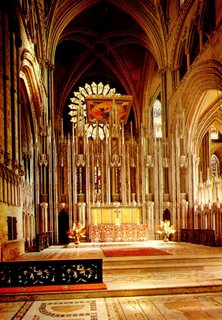


Altars were erected, holy water-stoups replaced, and everything prepared for the Holy Sacrifice. On Sunday, St. Andrew's Day 1569, the first High Mass was sung, the whole official choir assisting in the thronged Cathedral, and the reconciliation of Durham to the Church was crowned on December 4, then the second Sunday in Advent, by the priest F. Holmes bearing special faculties from Rome. Mounting the pulpit after preaching on the state of heresy and schism in the religion established by law, he exhorted his hearers to submit once more to the Holy See and to kneel down in proof thereof. He then publicly absolved the prostrate crowd, from their censure, and reconciled them to the Catholic Church. Holy Mass was then offered in reparation and thanksgiving.

"In the same day wherein the heathen had defiled it was it dedicated anew with canticles and harps and lutes and cymbals. And all the people fell upon their faces and adored and blessed up to Heaven Him that had prospered them." 1 MACH. iv. 54, 55.

We even know the identity of the organist at these Masses, one John Brimley.

His gravestone in the Galilee Chapel says:

John Brimleis body here doth li
Who praysed God with hand and voice
By musickes heavenlie harmonie
Dull myndes he maid in God rejoice
His soul into the heavens is lyft
To prayse him stil that gave the Gyft
Obiit Ao.Dni.1576 Octo.13.

Thursday, August 21, 2014

Blessed THOMAS PERCY, Layman., 1572


TORN from his friends and followers, from his wife and his four little girls, and betrayed into the hands of a declared enemy, B. Thomas in his captivity at Lochleven had indeed " sunk into deep waters among them that hated him " (Ps. Ixviii.). But he found strength from above in his continual fasts and watchings and pious meditations, and proved himself a true champion of the faith. His Calvinist keeper, the Lord of Lochleven, brought many of his sect to try and persuade him, by cunning argument and speeches or by threats and promises, to embrace their errors, but he could never be persuaded to depart in the smallest matter from the Communion of the Catholic Church. When, as often happened, meat was brought to him on days which Catholics observe as a fast, he contented himself with bread alone ; and by his example moved some of those attending on him to repent of their apostasy. The fortitude he thus acquired found a witness in Lord Hunsdon, who reported "that he is readier to talk of hawks and hounds than anything else, though very sorrowful and fearing for his life."

"Eleazer, one of the chief of the scribes, was pressed to eat swine's flesh. But he, choosing rather a most glorious death than a hateful life, went forward voluntarily to the torment."—2 MACH. vi. 18, 19

Wednesday, August 20, 2014

Blessed THOMAS PERCY, Layman, 1572


20 THIRTY PIECES OF SILVER

Biography

A GALLANT sight must have been the men of the Rising on the march. Nobles, knights with their tenants equipped for war, labourers and peasants unarmed but stout of heart, all wearing the Red Cross, their Standard the Five Sacred Wounds ;

its bearer, the grey-haired Richard Norton, late High Sheriff of Yorkshire. Among their chaplains, B. Thomas Plumtree, and heading the force the Earl and his brave-hearted Countess. They advanced as far south as Clifford Moor, near Wetherby, but their divided counsels and want of supplies forced them to retire, and at the advice of the Earl, anxious to avoid useless bloodshed, they dispersed. The cold-blooded revenge of Elizabeth displayed at once her avarice and cruelty. The gentlemen and yeomen were allowed to escape with a fine, but the peasants were hung by hundreds. The Earl fled to Scotland, and, consenting to meet an envoy from the Regent, was treacherously captured and confined in Lochleven. Thence after two years and a half imprisonment he was handed over to Elizabeth, who thirsted for his blood, for 2000 pounds. He was conveyed to York, where, after refusing to save his life by apostasy, he won his crown, August 22, 1572.


"But they appointed him thirty pieces of silver, and from thenceforth he sought opportunity to betray Him."—MATT. xxvi. 16.

Tuesday, August 12, 2014

Blessed THOMAS PERCY, Layman, 1572

THE ABOMINATION OF DESOLATION

Biography


THE freedom to practise their religion, which Catholics had regained under Mary, was rudely swept away by Elizabeth. By the Act of Supremacy the authority of the Pope was abolished, and his jurisdiction transferred to the Crown. By the Act of Uniformity the Holy Sacrifice of the Mass was prohibited, and in alj churches the Protestant Book of Common Prayer was alone to be used. Transgression of the above Acts incurred for the first offence forfeiture of property, for the second perpetual imprisonment, for the third death. Thus the sanctuaries revered for ages became empty sepulchres. The Royal Arms were substituted for the Crucifix, the images of Our Lady and the Saints were torn down, and the innumerable altars overturned and desecrated. Non-attendance at the Protestant Church was punishable with a fine ; the exercise of any priestly office with imprisonment—if repeated, with death. This sacrilegious usurpation of religious authority by the Crown, the privation of the Sacraments even at the hour of death, the absolute hopelessness of obtaining any constitutional redress, led to the Northern Rising, in which B. Thomas Percy, Earl of Northumberland, laid down his life for the faith.

"And behold our sanctuary and our beauty and our glory is laid waste, and the Gentiles have defiled them. To what end, then, should we live any longer?"—1 MACH. ii. 12.

Saturday, January 04, 2014

Blessed THOMAS PLUMTREE, Priest, 1572

THE VOICE OF THE PREACHER

Biography

BORN in the Diocese of Lincoln, a scholar of Corpus Christi College, Oxford, in 1546, he was made Rector of Stubton in his native county. He resigned his benefice on the change of religion under Elizabeth, and became a schoolmaster at Lincoln, but was obliged to resign the post on account of his faith. But it is as chief chaplain and priest of the army of the Northern Rising that he won the martyr's palm. His voice seems to have been like the Baptist's and to have stirred high and low alike. His call to abandon heresy and to rally to the standard of the faith ran through the northern counties, and hundreds came in response to his summons. He appears to have been celebrant of the Mass in Durham Cathedral immediately preceding F. Holmes' sermon and the public Absolution which followed. On his capture after the failure of the Rising, he was singled out as a notable example of the priests who had officiated. On the gibbet in the market-place at Durham 


he was offered his life if he would embrace heresy, but he refused, and dying to this world received eternal life from Christ. He suffered January 4 1572, and was buried in the market-place.

Wherein I labour even unto bands, but the word of God is not bound.—2 TIM. ii. 9.

Popular Posts